October marks Cybersecurity Awareness Month in Canada, a time to reflect on the importance of protecting our digital lives. With cyber threats becoming increasingly sophisticated, it’s crucial for individuals and businesses alike to prioritize cybersecurity measures. In this blog, we’ll discuss the significance of Cybersecurity Awareness Month and offer some top tips to help you […]
The post October is Cybersecurity Month: Top Tips for Online Safety appeared first on MCSnet.
]]>
October marks Cybersecurity Awareness Month in Canada, a time to reflect on the importance of protecting our digital lives. With cyber threats becoming increasingly sophisticated, it’s crucial for individuals and businesses alike to prioritize cybersecurity measures. In this blog, we’ll discuss the significance of Cybersecurity Awareness Month and offer some top tips to help you stay safe online.
Why Cybersecurity Awareness Month Matters
Cybersecurity Awareness Month serves as a reminder that online safety is a shared responsibility. It aims to educate and empower individuals to take proactive steps to protect their personal information and sensitive data. By raising awareness about cyber threats and best practices, we can collectively build a more secure online environment.
Tips for Getting Cyber Safe
Stay Updated
Ensure your operating system, software, and applications are updated regularly. Often, these updates include patches for security vulnerabilities that have been discovered since the last version.
Strong Passwords
Opt for complex passwords that combine uppercase and lowercase letters, numbers, and special symbols. Avoid using the same password for multiple accounts and consider using a password manager to keep track.
Multi-Factor Authentication
Where possible, enable multi-factor authentication (MFA). This provides an additional layer of security, ensuring that even if someone knows your password, they can’t access your account without a second verification method.
Be Wary of Suspicious Emails and Links
Phishing remains a common cyber threat. Always check the email address of the sender, and avoid clicking on suspicious links or downloading attachments from unknown sources. You can report suspicious text messages to 7726.
Secure Your Home Network
Change the default username and password on your router. Consider setting up a guest network for visitors so they don’t have access to your main network where your devices might be connected.
Use a VPN
If you’re using public Wi-Fi, consider using a Virtual Private Network (VPN). A VPN encrypts your internet connection, making it harder for cybercriminals to intercept your data. We suggest OpenVPN.
Regular Backups
Regularly backup your data, both physically and in the cloud. If something goes wrong, like a ransomware attack, you’ll be grateful to have an untouched copy of your data to restore.
Educate Yourself and Others
Stay informed about the latest cyber threats and protection methods. Attend webinars, read articles, and consider taking courses. Knowledge is power, after all.
Invest in Security Software
Use reputable antivirus and anti-malware software to protect your devices. They can detect and remove a wide range of threats before they inflict damage. If you have Windows installed on your computer, you are all set with Windows Security Essentials.
Limit Social Media Exposure
Be careful about what you share online. Cybercriminals often use information from social media to craft personalized phishing attacks or to guess security questions
The folks over at GetCyberSafe.ca have a lot of great resources for Cybersecurity Month and an online quiz to see if you are being cyber safe. By following these tips and keeping alert to existing cyber threats, you will be able to sip your pumpkin spice latte in peace knowing you are cyber secure.
Click on over to our Cybersecurity Best Practices webpage for more tips.
The post October is Cybersecurity Month: Top Tips for Online Safety appeared first on MCSnet.
]]>Is 50 Mbps fast enough? What about 100 Mbps? Do I need 1000 Mbps? There’s a reason why these are some of the most common questions we hear from customers when selecting a plan. If you’re not especially techie, looking at the different speeds when selecting an internet plan can leave you scratching your head. […]
The post How Much Internet Speed Do You Need? appeared first on MCSnet.
]]>
Is 50 Mbps fast enough? What about 100 Mbps? Do I need 1000 Mbps?
There’s a reason why these are some of the most common questions we hear from customers when selecting a plan. If you’re not especially techie, looking at the different speeds when selecting an internet plan can leave you scratching your head.
In today’s world, good internet speed can be the difference between moving quickly through your day and being endlessly frustrated by lag and buffering. At MCSnet, we know that matching you up with the right internet speed for your needs is crucial and we’re happy to help.
In this comprehensive guide, we’ll explain how much speed is required for various online activities, how to determine your own speed needs, how to test your current speeds, what may be slowing your internet down, and even provide some plan options.
Let’s get started with a quick dive into 50 Mbps and what that means for internet speed.
How fast is 50 Mbps?
If you’re asking, “What is Mbps and why does it matter?”, we’ll break it down for you.
Mbps means megabits per second, which is how we quantify how much data your internet connection can transfer to your device in one second. This unit of measurement is an industry standard for describing the speed you can expect in an internet plan for uploading and downloading content.
Megabit (written as Mb) is commonly confused with megabyte ( written as MB), which is a different measurement (1 megabyte = 8 megabits). Also, Mbps is megabits per second, while MBps is megabytes per second. For a more in-depth explanation, we break it down further here.
When thinking about 50 Mbps in terms of speed, you can get a general idea of how fast a download will take if you know its size. Here is a quick formula to determine download and upload speed:
Size [MB] / Speed [MBps*] = Time [seconds]
*50 Mbps (megabits per second) is equal to 6.25 MBps (megabytes per second)
For example, if you’re downloading music that is 100 MB (megabytes) in size, at 50 megabits per second (or 6.25 megabytes per second), you could figure that out using the formula:
100 MB / 6.25 MBps = 16 seconds
So, this file will take about 16 seconds to download or upload at 50 Mbps.
Of course, this isn’t a perfect science. Often, we have other factors at play that can impact our internet speed. We’ll get into more detail on this next.
Internet speed: not as simple as Mbps
Often, slow internet speeds are the result of a number of factors that have nothing to do with your internet plan. Here are some common ones:
Network congestion
You may already know that running multiple devices at once can have a significant impact on your internet speed. But did you know that your network may be slowed down before the internet even reaches your home?
Just like rush hour traffic, your internet can experience its own version of congestion (commonly referred to as peak-time lag). This is the result of numerous users across your provider’s network drawing bandwidth at the same time, commonly during evening hours.
At MCSnet, we use a private network specifically designed for rural Alberta, so our customers experience the best possible speeds. Keep in mind that we still connect to the main internet exchange, but by using dedicated Google and Netflix servers, for example, your connection to these services isn’t going all the way to the main Seattle internet exchange and back.
Quality of cables
Since the advent of Wi-Fi, several of us think cables are a thing of the past. But our cables that carry data to and around our home can significantly influence the speed and quality of our connection.
Our advice? Don’t cheap out on ethernet cables, and ensure your cables can support the speeds you need. Secondly, make sure your ethernet cables are set up correctly for faster internet.
Device capability
If you’re still using the same devices you have for years, it may be time to upgrade – especially if you have a new high-speed internet plan. Your device’s processor might not be able to handle your internet speeds.
Routers are another example. Older routers weren’t built for the internet speeds of today and can throttle high speeds, turning your waterfall of data into just a trickle.
If you’re a customer of ours, don’t worry – we ensure our customers are always using the right router for their plan.
Weather and wireless download speed
All networks, especially space-based satellite networks, can suffer from network slowness during heavy precipitation/storms, extreme temperatures, wind, and more. Ensure that your provider has the infrastructure built for the rough and extreme conditions found in rural Alberta.
You should now have a general understanding of what Mbps means, how to figure out speeds based on file size, and the barriers that may stand in your way of experiencing your full network speeds. Now, let’s get into the good stuff: will 50 Mbps cut it for your lifestyle?
Is 50 Mbps good for streaming and gaming?
When it comes to selecting the right internet speeds, two bandwidth-heavy activities stand out among the rest: modern streaming and gaming. If you’ve ever had a movie marathon interrupted by buffering, or a high score opportunity cut short by lag, you understand the frustration of internet speeds that just can’t keep up with your lifestyle.
To begin, let’s look at streaming and how 50 Mbps stacks up for your next Netflix binge:
Streaming internet in 4K
Not that long ago, 1080p was the gold standard for streaming movies and TV. Today, we are able to stream in even better clarity in 4K (which requires five times more data than 1080p!), and as of very recently, 8K is quickly taking the world by storm.
As the world of graphics and clarity advances quickly, so must our internet to transmit the data required for crisp, high-definition imagery.
Is 50 Mbps enough?
Streaming in 4K requires about 25 Mbps of speed (Consumer Reports, 2019) for consistent streaming and no buffering. This gives you a bit of wiggle room to use other devices at the same time, but if you have several movie buffs or YouTube lovers in your household streaming in 4K at once, you may experience some buffering and slowness. If this is the case, a plan with higher Mbps is best for you.
Gaming at the speed of light
Similar to the advancements in streaming TV and movies, upgraded gaming systems with advanced graphics and immersive experiences require significantly more bandwidth than gaming consoles even just a few years ago. When it comes to gaming, speed is crucial, but a reliable connection is the real game-changer.
Additionally, games tend to require frequent updates to patch any bugs or glitches. When you have sufficient bandwidth, these updates are quick and painless. But on slower plans, these updates can take a long time and seriously impact your gaming experience.
Is 50 Mbps enough?
If you enjoy online, browser-based, or app-based games, 50 Mbps should be plenty to support your gaming – a 5 Mbps speed should be all you need per game.
However, if you are using high-end gaming consoles, especially with virtual reality immersive games, you will need a lot more in terms of bandwidth. As a general rule, anything less than 25 Mbps (Stream Scheme, 2023) and you run the risk of lag.
If you live in a household where several devices are accessing the internet at once, 50 Mbps may be cutting your bandwidth a bit close. If you have another gamer or movie streamer using the internet at the same time, you definitely should explore plans with bandwidth higher than 50 Mbps.
Latency and gaming
Another factor to consider when selecting a plan as a gamer is latency. Latency, or “ping”, is crucial for a responsive gaming experience. At MCSnet, our network is among the lowest for latency (a good thing for gamers!), so you know that your gaming experience is seamless.
For the majority of streamers and gamers, a 50 Mbps plan should be plenty for a seamless experience. This speed supports the demands of these high-bandwidth activities while offering the reliability of direct-to-home fiber optic connection.
If your network needs to support more than one high-bandwidth activity at once, it may be a good idea to invest in a higher bandwidth plan to ensure your activities are seamless. You can review our residential plans here.
Streaming and gaming are just two high-bandwidth activities to consider when selecting the right plan for you. Next, we’ll get into the world of downloading, uploading, and additional devices.
Downloading and uploading on 50 Mbps
These days, with the ease of posting on social media and downloading recipes for dinner, we are all actively downloading and uploading content constantly.
As more of us work from home than ever, hefty file downloads and video conferences can require a large chunk of our bandwidth. Downloading or uploading large files on a slow internet plan can feel like an eternity.
So how does 50 Mbps stack up for these daily activities? The answer: as always, it depends.
What’s the difference between downloading and uploading?
Before we get into some time estimates, we’ll begin by explaining the difference between downloading and uploading. While downloading brings content to your device from the internet, uploading sends data from your device out into the internet.
Streaming a movie is a form of downloading since the movie is being brought to your device. Sending an e-mail is a form of uploading since you’re sending data out from your device into the internet. Video conferencing uses both downloading and uploading, since you’re viewing others and they’re viewing you simultaneously.
When selecting an internet plan, be aware of both the download and upload speeds, as they can often be different.
How fast is 50 Mbps for downloading and uploading?
Here are some time estimates for common tasks on a 50 Mbps plan. It’s important to note that, again, these estimates assume that no other devices are using the internet, so they can vary greatly.
How fast is 100 Mbps?
When thinking about 100 Mbps in terms of speed, you can get a general idea of how fast a download will take if you know its size. Here is a quick formula to determine download and upload speed:
Size [MB] / Speed [MBps*] = Time [seconds]
*100 Mbps (megabits per second) is equal to 12.50 MBps (megabytes per second)
For example, if you’re downloading music that is 100 MB (megabytes) in size, at 100 megabits per second (or 12.50 MBps megabytes per second), you could figure that out using the formula:
100 MB / 12.50 MBps = 8 seconds
So, this file will take about 8 seconds to download or upload at 100 Mbps.
Is 100 Mbps good for streaming and gaming?
When choosing the right internet speeds, two bandwidth-intensive activities stand out: modern streaming and gaming. If buffering has disrupted your movie marathon or lag has ended your high score attempt, you know the frustration of inadequate internet speeds.
Let’s start by assessing streaming and how 100 Mbps handles your next Netflix binge:
Streaming in 4K
Not long ago, 1080p was the standard for streaming movies and TV. Today, we can stream in 4K, which needs five times the data of 1080p, and 8K is rapidly gaining popularity.
As graphics and clarity advance, our internet speeds must also keep up to handle the data needed for sharp, high-definition visuals.
Is 100 Mbps enough?
Streaming in 4K requires around 25 Mbps for consistent playback without buffering (Consumer Reports, 2019). This speed allows room for other devices to be used simultaneously. However, if multiple people in your household stream 4K content simultaneously, buffering and slowness might occur. In this case, a plan with a higher Mbps would be more suitable.
Gaming at the speed of light
Gaming systems now feature cutting-edge graphics and immersive experiences that need significantly more bandwidth than older consoles. Speed is essential for gaming, but a stable and reliable connection is crucial. Games often require updates to fix bugs or glitches, and with adequate bandwidth, these updates are quick. However, slower connections can lead to lengthy updates that disrupt the gaming experience.
Is 100 Mbps enough?
For online, browser-based, or app-based games, 100 Mbps is usually sufficient, and each game typically requires about 5 Mbps. High-end gaming consoles, especially for virtual reality, need significantly more bandwidth, with anything less than 25 Mbps risking lag (Stream Scheme, 2023). In households with multiple devices accessing the internet simultaneously, 100 Mbps may be limiting. If another gamer or movie streamer is online at the same time, consider plans exceeding 100 Mbps.
Latency and gaming
Review the available MCSnet residential plans for more details.
Streaming and gaming are just two high-bandwidth activities to consider when selecting the right plan for you. Next, we’ll get into the world of downloading, uploading, and additional devices.
Downloading and uploading on 100 Mbps
With the ease of posting on social media and downloading recipes, we’re constantly downloading and uploading content. As more people work from home, large file downloads and video conferences can significantly consume bandwidth.
Slow internet plans make these tasks feel excruciatingly long. How does a 100 Mbps plan hold up for these activities? As always, it depends on your specific usage needs.
How fast is 100 Mbps for downloading and uploading?
Here are some time estimates for common tasks on a 50 Mbps plan. 100Mbps plan will be twice as fast. It’s important to note that, again, these estimates assume that no other devices are using the internet, so they can vary greatly.

If you want faster speeds, doubling your 50 Mbps plan to 100 Mbps will cut these times in half.
Overall, if you’re an average user with small-to-moderate downloads and uploads, 50 Mbps should be plenty for your needs. If you have above-average download needs working with large files (like a photographer or graphic designer), you may want to opt for higher bandwidth.
Additionally, if there are several users in your household, you also may want the extra speed on your plan. We’ll explain more about that next.
How many people can use 50 Mbps?
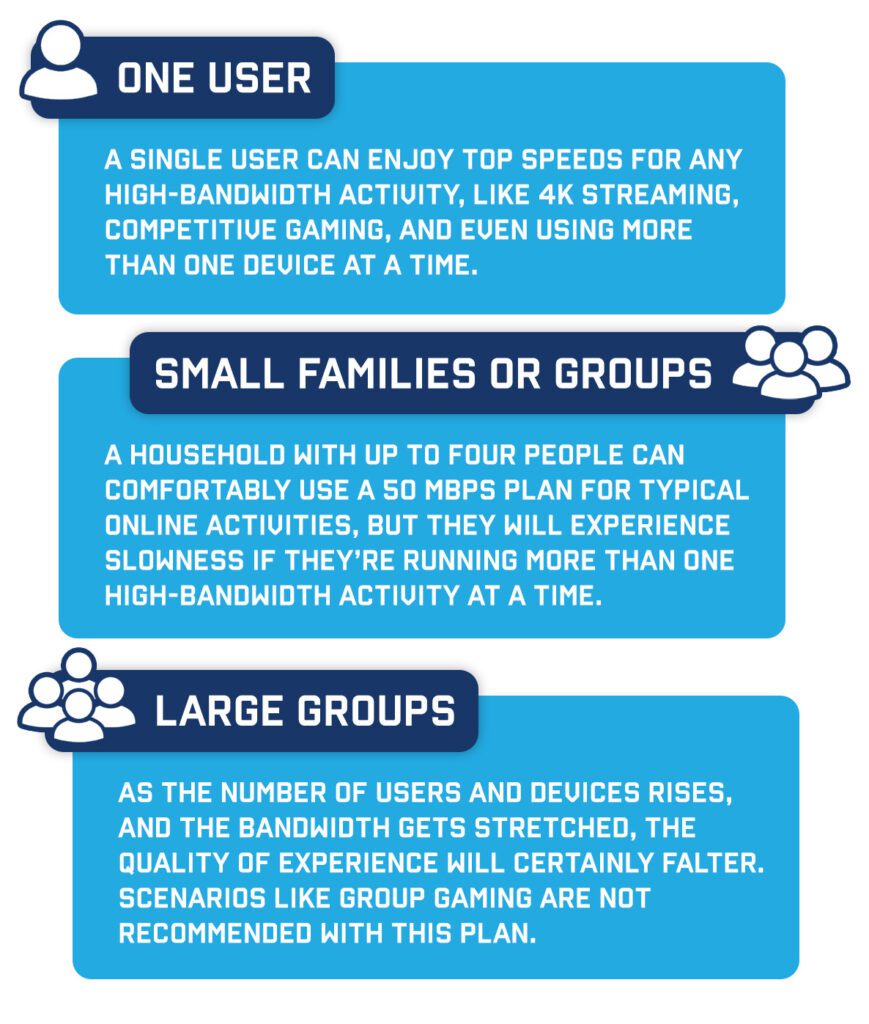
While a 50 Mbps plan should provide a solid foundation for multiple users to engage in various online activities at the same time, it depends on how much bandwidth is being used at once. Understandably, a household with multiple devices streaming or gaming at once can seriously impact speed and experience!
Here is how a 50 Mbps plan would perform in the following scenarios:
Speed aside – how much data do I need?
When it comes to determining your specific data needs, we can help. We break it down for you in our blog post and Internet Buyer’s Guide.
If you need a plan that can keep up with your heaviest bandwidth demands, we have a variety of residential plans perfect for all different types of users. Review our internet plans here.
Testing your internet speeds
Before making the switch to a different ISP or plan, you can perform an internet speed test to see what speeds you’re currently working with. Regularly checking your internet speed is a good practice to ensure you’re receiving the service you’re subscribed to. Follow the steps below or learn more about how to test your internet speed here.
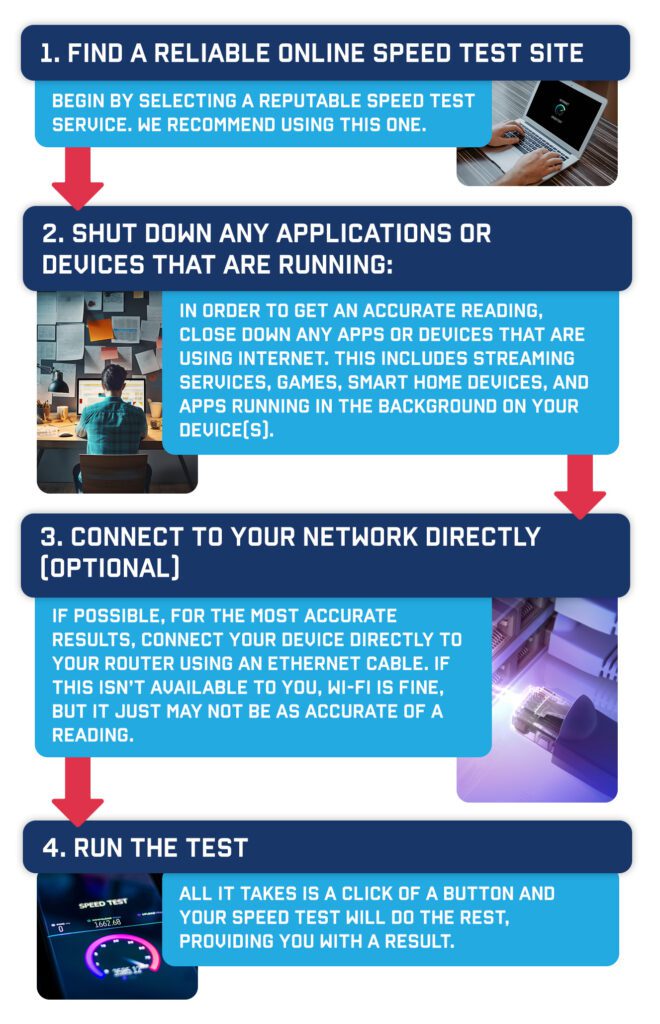
After completing your test, you’ll notice metrics about your connection, but remember, our plans are centered around traffic caps, not specific speed rates. We strive to provide the best possible speed by optimizing your connection to the nearest tower. While speed readings may vary, they are influenced by factors like network congestion, server distance, and background device activity.
Additionally, you’ll see a metric known as Latency or Ping. This is crucial as it indicates the responsiveness of your connection, with lower numbers being preferable. Ideally, your latency should be between 20-40 milliseconds (ms), ensuring a smoother, more efficient online experience.
If your internet speed is strong, but you’re experiencing slowness that seems out of character for your activities, you may want to consider an internet speed booster before switching to another plan (learn more here).
Once you have an understanding of your download speeds, upload speeds, and latency, you can head into the next phase of the decision to switch.
Deciding to switch: Evaluating speed and need
By now, you should have a general understanding of what a 50 Mbps plan can do for you and how much speed you’re currently getting. Now, it’s time to piece everything together. Here is a checklist to go through before deciding to switch.
Key considerations before switching internet plans
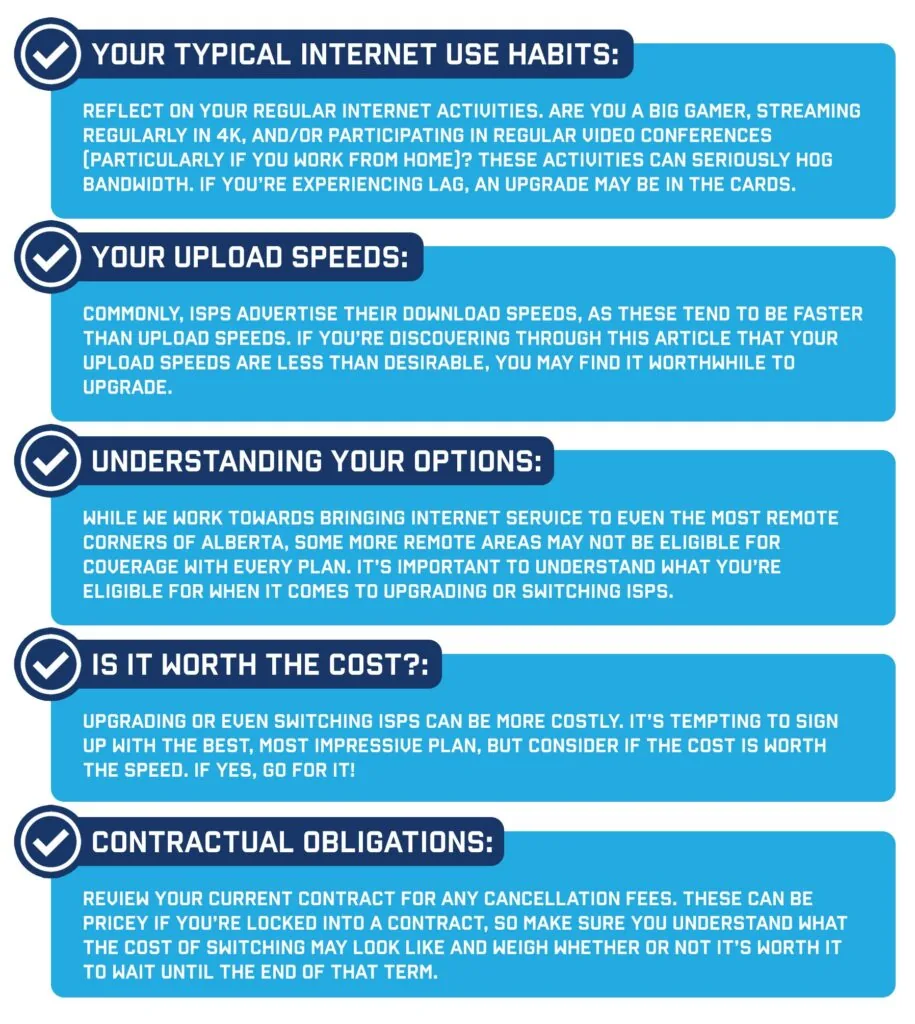
Ultimately, if you’ve determined that you are ready for an upgrade, we hope we’ve equipped you with the knowledge to select the best plan for your needs.
If you’re still on the fence, we have one more key consideration for you as you make this decision: making sure your internet can keep up with the advancements coming our way.
Future-proofing your internet
If there’s one thing we know for sure about the future, it’s that there’s no slowing down tech advancements. In fact, the demand for global data traffic increases by 40% every year (McGill, 2023).
As streaming becomes clearer, gaming becomes more immersive and realistic, and working from home becomes more widespread, we are going to continue to need more and more from our internet speeds.
If you’re signing a contract, you want to ensure that your internet speeds will support your activities that entire term. Investing in higher speeds today may set you up for a seamless internet experience tomorrow.
Do most people really need 1000 Mbps?
No. For roughly 80% to 90% of households, 1000 Mbps is total overkill.
Basic online activities use surprisingly little bandwidth:
- Netflix in 4K: ~15–25 Mbps
- Zoom Video Call: ~3–4 Mbps
- Spotify / Web Browsing: < 5 Mbps
A household of four people where two adults work from home and two kids stream 4K video simultaneously barely consumes 50-100 Mbps at peak usage.
Who Actually Benefits from 1000 Mbps?
While optional for average users, 1 Gig is a genuine necessity for four specific groups:
- Large/Dense Households (5+ Heavy Internet Users): Homes where multiple people are simultaneously streaming 4K video, attending Zoom calls, uploading files, and gaming online.
- Hardcore Gamers: Modern games (like Call of Duty) regularly require 100 GB+ downloads and frequent multi-gigabyte patches. 1 Gig reduces hours of waiting to a few minutes.
- Content Creators & Remote Professionals: Videographers, designers, and software engineers who constantly upload massive 4K video files, RAW photo folders, or large codebase archives to cloud servers benefit heavily.
- Smart Home Super-Users: Residences running dozens of cloud-connected security cameras, smart TVs, IoT appliances, and background cloud backups simultaneously.
TL:DR:
Don’t pay for capacity you won’t use. 50 to 100 Mbps is the sweet spot for everyday reliability and budget-conscious households. Upgrade to 1000 Mbps only if long download bars are disrupting your workflow, or if your household routinely experiences speed drops when everyone gets online at the same time.
Conclusion
To wrap up this guide, let’s go back to our initial question: is 50 Mbps fast enough?
Ultimately, it depends! 50 Mbps should be sufficient for a single user to engage in even the most demanding activities or general internet use for several users. If several users are relying on 50 Mbps for high-bandwidth activities, they may experience some lag, and a higher-speed plan may be best.
Deciding to make the switch to a better plan or different ISP is not easy, nor is it one that should be taken lightly. Hopefully, by now, you have gained a better understanding of your internet needs and whether or not making the switch is the right decision for you.
When you sign up with us, you get unmatched customer service (our St. Paul-based customer service team answers our calls – no dealing with robots here!) and a commitment to serving rural Alberta.
Connect with us today and we’ll match you up with the best plan for your needs.
Internet Speed Questions We’re Asked Frequently
No, 50 Mbps is not slow, and most average users will find it suits their daily activities well. 50 Mbps might be too slow for high-bandwidth households, especially if gaming, streaming in 4K or 8K, or with several users accessing the internet at once.
Yes, 50 Mbps is generally fast enough to handle most average work from home activities, including seamless video conferencing, small-to-moderate file uploads, and emails.
However, if you do the type of work that requires frequent large file uploads and downloads, or if multiple people are working from your home at once, you may want to opt for a faster plan.
Yes, 50 Mbps is good for 4K streaming. As a general rule, 25 Mbps is the minimum speed recommended for 4K streaming. However, if you’re streaming in 8K or have more than one internet user streaming at once, you may run into some buffering delays.
50 MB and 50 Mb are commonly confused, but these are two different measurements. MB (megabytes) is used to measure data usage and caps in an internet plan, while a Mb (megabit) is 1/8th the size of a megabyte and is used to measure speed per second.
50 MB of data is an incredibly small amount of data in your internet plan. For context, you use about 1GB (1000 MB) of data per hour of streaming.
Conversely, 50 Mbps (megabits per second) of internet speed is relatively fast and could download that 1 GB of data in under 3 minutes.
No, 100 Mbps is not slow and should suit the daily activities of most average users well. However, it might be too slow for high-bandwidth households, especially if they’re gaming, streaming in 4K or 8K, or if multiple users are accessing the internet simultaneously.
In most cases, yes, a 100 Mbps (Megabits per second) internet connection is generally considered fast enough to support common work-from-home activities for an average household. This bandwidth should be sufficient for seamless video conferencing on platforms like Zoom, Microsoft Teams, or Google Meet, which typically require download speeds of 1.5-3 Mbps for high-quality 1080p video.
Additionally, a 100 Mbps plan can comfortably handle common tasks such as sending and receiving emails, browsing the web, streaming music from services like Spotify or Apple Music, and uploading or downloading small-to-moderate file sizes commonly associated with office work.
However, it’s important to note that if your work involves frequent large file uploads or downloads, such as transferring high-resolution videos, CAD files, or large databases, a 100 Mbps connection may feel somewhat constrained, especially if multiple people in the household are working from home simultaneously and sharing the bandwidth.
Yes, a 100 Mbps (Megabits per second) internet connection is generally considered good and sufficient for streaming 4K (3840 x 2160 resolution) content from popular platforms like Netflix and YouTube. Both Netflix and YouTube recommend a minimum download speed of around 25 Mbps for seamless 4K streaming.
With a 100 Mbps plan, you should be able to stream 4K videos on these platforms without any significant buffering or quality issues. In fact, this bandwidth would allow you to stream multiple 4K streams simultaneously, as long as you don’t have too many other bandwidth-intensive activities running concurrently.
However, it’s important to note that if you plan to stream content in even higher resolutions, such as 8K (7680 x 4320), or if you have multiple people in your household streaming 4K content simultaneously across different devices, a 100 Mbps connection may start to feel constrained, and you might encounter occasional buffering delays or quality dips.
In such scenarios, or if you frequently engage in other high-bandwidth activities like online gaming, video conferencing, or large file transfers while streaming, it may be advisable to consider upgrading to a faster internet plan.
100 MB (megabytes) and 100 Mb (megabits) are different measurements often confused. MB measures data usage and caps in an internet plan, while Mb, being 1/8th the size of a megabyte, measures speed per second.
100 MB of data is a small amount within an internet plan. For reference, streaming uses around 1 GB (1000 MB) per hour. Conversely, 100 Mbps (megabits per second) is relatively fast and can download 1 GB of data in under 2 minutes.
Consider upgrading only if your household habits change significantly. If you start working full-time in video production, add multiple heavy gamers who regularly download 100 GB game patches, or expand your household to 5+ active internet users streaming concurrently, upgrading to Gigabit will save you time. Otherwise, stick with 50–100 Mbps and keep the savings.
Buffering is usually caused by a weak Wi-Fi signal or local network congestion, not a slow internet plan. Obstructions like concrete walls, distance from the router, or outdated router hardware degrade speed over Wi-Fi. Upgrading to a 1,000 Mbps plan won’t fix dead zones in your home; investing in a modern mesh Wi-Fi system or relocating your router will.
No. Bandwidth (Mbps) measures how much data can travel at once, whereas latency/ping (measured in milliseconds) measures how fast data travels between your device and the game server. Online gaming uses very little bandwidth (around 3 to 6 Mbps). A 1,000 Mbps connection won’t reduce your ping compared to a 100 Mbps connection on the same network technology. For the lowest latency, plug your gaming device directly into the router via an Ethernet cable.
A 100 Mbps plan can easily support 10 to 15 connected devices doing everyday tasks like social media, smart home automation, background updates, and light browsing. When it comes to high-bandwidth tasks, 100 Mbps can run up to four simultaneous 4K video streams without buffering.
The post How Much Internet Speed Do You Need? appeared first on MCSnet.
]]>The technology delivering internet to your home can influence its availability, performance, installation requirements and consistency. Fiber, fixed wireless, 5G home internet and satellite internet can all provide high-speed connectivity, but they reach your home in very different ways. This guide explains the major internet connection types and helps you determine which option may be […]
The post Full Guide to Internet Connection Types: Fiber vs. Fixed Wireless vs. 5G vs. Satellite Internet appeared first on MCSnet.
]]>The technology delivering internet to your home can influence its availability, performance, installation requirements and consistency. Fiber, fixed wireless, 5G home internet and satellite internet can all provide high-speed connectivity, but they reach your home in very different ways.
This guide explains the major internet connection types and helps you determine which option may be the best fit for your home, business and location.
Why Your Internet Connection Type Matters
Your internet plan tells you how much speed and data you are buying. Your connection type describes how that service travels from the provider’s network to your property.
That difference matters because two plans advertising similar download speeds may not provide the same experience. Their upload speeds, latency, coverage, installation process and performance during busy periods can vary.
More than 96% of Canadian dwellings now have access to internet service meeting or exceeding the national universal service objective, but the technologies available still vary by address.
| Connection type | How it reaches your home | Key strength | Important consideration |
| Fiber internet | Data travels through fiber-optic cables | Very high capacity and strong upload performance | Not available at every address |
| Fixed wireless internet | Radio signal travels from a nearby tower to a receiver at the property | Extends high-speed internet without running cable to every home | Requires suitable coverage and, in some cases, line of sight |
| 5G home internet | A home gateway connects to a mobile 5G or LTE network | Similar setup to fixed wireless internet | Performance can depend on signal strength and network demand |
| Satellite internet | Data travels between a home dish and satellites in space | Can reach remote properties beyond terrestrial networks | Requires suitable dish placement and may have higher or more variable latency |
What Is Fiber Optic Internet?
Fiber internet uses thin strands of glass or plastic to transmit data as pulses of light. Because light can carry large amounts of information efficiently, fiber can provide very high download and upload speeds with substantial network capacity.
The CRTC describes fiber-optic internet as using light to carry data, allowing for faster speeds and greater bandwidth than many older technologies.
How Fiber Internet Works
With Fiber-to-the-Home, or FTTH, the fiber connection runs directly to the customer’s property. Inside the home, an optical network terminal converts the fiber signal into a connection that can be used by the router and household devices.
Benefits of Fiber Internet
Fiber is often a strong choice for households with demanding or simultaneous internet use. Its large capacity can support multiple people streaming, gaming, attending video meetings and uploading files at the same time.
It is also commonly associated with symmetrical or near-symmetrical plans, where upload speed is close to download speed. Strong upload performance is valuable for cloud backups, video production, security cameras and remote work.
Fiber internet is also one of the most reliable types of internet technologies because it is not affected by weather when it is buried underground.
Limitations of Fiber Internet
The main limitation is availability. Extending fiber requires physical network construction, so it may not yet reach every neighbourhood, acreage, or rural property.
Installation can also require an exterior connection point, access to the home and, in some cases, underground work. These requirements depend on the infrastructure already available at the property.
What Is Fixed Wireless Internet?
Fixed wireless internet delivers service from a provider’s tower or access point to a receiver installed at a fixed location, such as a home, farm or business. The receiver then connects to equipment inside the property, where a router distributes the connection over Wi-Fi or ethernet.
Unlike fiber, fixed wireless does not require a physical cable to be installed all the way from the network to every customer. This makes it an important high-speed internet option in rural and regional areas. The CRTC defines fixed wireless as service delivered between network towers and customers using radio waves, primarily at fixed locations.
How Fixed Wireless Internet Works
A provider connects its towers to a broader network, often using fiber or high-capacity wireless links. A radio installed at the customer’s property communicates with a nearby tower.
The quality of the connection can depend on several factors, including:
- Distance from the tower
- Available network capacity
- Radio technology
- Terrain and obstructions
- The customer’s equipment
- Signal quality at the property
Some fixed wireless systems require a clear line of sight between the receiver and the tower, while others can tolerate a degree of obstruction.
Benefits of Fixed Wireless Internet
Fixed wireless can bring high-speed service to areas where installing wired infrastructure to every property would take longer or cost significantly more. Installation is often less invasive because the provider does not need to trench a cable across the entire property.
It can also provide lower latency than connections that must travel much farther before reaching the wider internet, although actual latency depends on the provider, network, and location.
Limitations of Fixed Wireless Internet
Availability is still address specific. A provider may serve a community while being unable to connect a particular property because of distance, terrain or signal conditions.
Performance can also differ between providers because fixed wireless is a broad category covering many frequencies, network designs, and generations of equipment.
What Is 5G Home Internet?
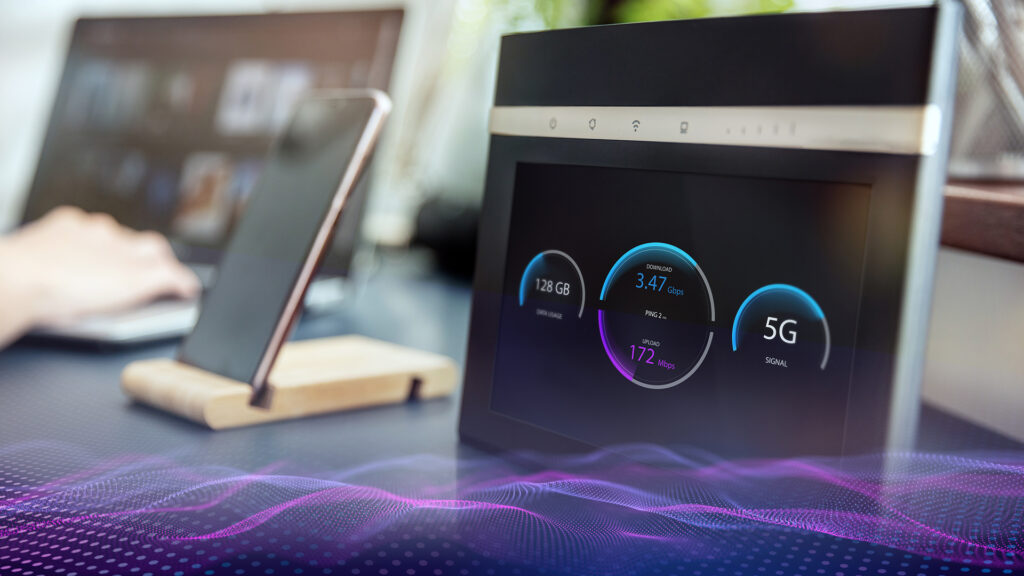
5G is a commonly-used term to describe the fifth generation of wireless cellular technology. It uses higher radio frequency bands and wider channels than 4G.
5G home internet uses a gateway installed inside or near the home to connect to a nearby mobile network. The gateway then creates a Wi-Fi network for household devices.
The system is similar to using cellular data on a phone, but the gateway is intended to remain at the service address and support the home’s regular internet use.
Benefits of 5G Home Internet
The biggest advantage is often convenience. Setup may be as simple as placing the gateway in an area with a strong signal and following instructions through an app.
It can be a practical alternative where wired internet options are limited but mobile coverage is strong. Canada’s connectivity strategy has also identified 5G-based fixed wireless as a way to expand last-mile connectivity without laying a cable to every property.
Limitations of 5G Home Internet
5G performance is highly dependent on location. Signal strength can change based on distance from the tower, building materials, terrain and where the gateway is placed inside the home.
Available capacity may also be shared with other users on the mobile network. As a result, performance can vary during periods of greater local demand.
The term “5G” does not automatically guarantee a specific speed. Users should compare the plan’s expected performance and test the service at their exact address rather than relying on the technology name alone.
Is 5G Home Internet the Same as Fixed Wireless?
5G home internet is a form of fixed wireless access, but not every fixed wireless connection uses 5G.
The term “fixed wireless” describes the broader delivery model: internet reaches a fixed property wirelessly instead of through a cable running all the way to the building. A 5G home internet service uses a provider’s mobile 5G or LTE network for that connection.
Other fixed wireless providers may use different licensed or unlicensed radio technologies, dedicated towers and equipment designed specifically for home or business broadband.
What Is Satellite Internet?
Satellite internet sends data between a dish at the customer’s property, satellites in orbit, and ground stations connected to the wider internet.
Traditional satellite systems generally use satellites positioned far above earth. Newer low-earth-orbit, or LEO, systems use groups of satellites operating closer to earth to reduce latency and increase performance.
How Satellite Internet Works
A satellite dish must be installed where it has a sufficiently clear view of the sky. The dish communicates with satellites passing overhead, which relay data through the provider’s network.
Satellite can cover locations that terrestrial networks cannot easily reach, making it a valuable option for remote homes, cabins, worksites, and mobile users.
Benefits of Satellite Internet
Its major advantage is geographic reach. Satellite service can connect properties beyond fiber, fixed wireless, and 5G cellular coverage.
Modern LEO services can also provide substantially lower latency than older geostationary satellite systems. For context, Starlink publishes expected land-based latency ranges of approximately 25 to 60 milliseconds, although performance varies by location and network conditions.
Limitations of Satellite Internet
The service requires suitable dish placement and an open view of the sky. Trees, structures, or other obstructions can interfere with the connection.
Performance may also fluctuate based on local capacity, obstructions, weather, equipment placement, and the number of customers using the network. Customers should also consider equipment costs, installation responsibilities, and available support when comparing satellite plans.
Fiber vs. Fixed Wireless vs. 5G vs. Satellite: Key Differences

Speed
Fiber generally offers the greatest capacity and highest potential speeds. Some advanced fixed wireless systems, like MCSnet’s GigAir, can also deliver fiber-like speeds, particularly where towers are supported by high-capacity fiber backhaul.
5G home internet can provide strong download performance where the signal and network capacity are good. Satellite speeds have improved considerably, but performance can vary by location and network demand.
The most useful comparison is not the highest speed each technology could theoretically achieve. It is the realistic plan available at your address, and made for your community.
Fiber typically provides the strongest upload options. Fixed wireless upload performance varies by technology and plan. Many 5G home and satellite plans are more download-heavy, with lower upload speeds than their advertised downloads.
Latency
Latency is the time it takes data to travel to its destination and return. Lower latency creates a more responsive experience for video calls, gaming, remote desktops, and cloud applications.
Fiber and well-designed terrestrial fixed wireless networks can provide low latency. 5G can also perform well when the customer has a strong connection to a nearby tower. LEO satellite has significantly reduced satellite latency, but the signal still follows a different and often longer network path.
Installation
Fiber usually requires a physical connection to the property and equipment inside the home. Fixed wireless normally requires an outdoor receiver and a signal test. A 5G gateway may be self-installed, depending on the techology. Satellite requires a dish with an appropriate view of the sky.
Professional installation is valuable when exterior equipment, cable routing, or signal alignment is involved.
Which Internet Connection Type Is Best?
There is no single connection type that is best for every property.
Choose fiber when it is available and your household needs high capacity, strong uploads or long-term scalability.
Consider fixed wireless when you need reliable high-speed service in a rural or regional area and a provider that can establish a strong connection to your property. Although, the newest fixed-wireless technology can provide fiber-like speeds and is available in more urban areas.
Consider 5G home internet when cellular coverage is strong, your usage is moderate, and you value simple setup.
Consider satellite internet when your property is beyond practical fiber, fixed wireless, or cellular coverage.
Explore MCSnet’s Advanced Internet Technologies Built for Rural Communities
MCSnet uses multiple technologies to bring reliable connection to rural properties. Depending on availability, customers may be served through Fiber Optics, Fixed Wireless or GigAir.
MCSnet is one of Canada’s largest privately-owned internet service providers and has built its own private network with more than 500 fixed wireless towers and 2,000 kilometres of buried transit fiber. That infrastructure helps connect homes, farms, communities and businesses across Northeastern Alberta and Western Saskatchewan.
MCSnet’s GigAir expands those options further. It uses high-capacity fiber or wireless connections to feed local towers, then sends the service wirelessly to a small receiver at the customer’s property. In supported communities, GigAir can provide fiber-like speeds of up to 940 Mbps without requiring the customer’s driveway or yard to be trenched.
Rather than asking customers to choose a technology without knowing what their property can support, MCSnet starts with the address. Available speeds and plans are then matched to the technology that can serve that location.
Learn more about MCSnet’s Internet Technologies
Check MCSnet availability at your address to find the internet technology and plan available for your home or business.
Frequently Asked Questions
What are the main types of internet connections?
The main home internet types include Fiber, cable, DSL, fixed wireless, 5G home internet and satellite. Availability varies by provider and address.
Is fiber better than fixed wireless internet?
Fiber generally provides greater capacity and stronger upload speeds, but advanced fixed wireless can deliver excellent performance where fiber has not reached the property. The better choice depends on the actual plans and infrastructure available at your address.
Is fixed wireless better than satellite internet?
Fixed wireless may offer a shorter terrestrial network path and professional local installation, while satellites can reach properties beyond tower-based coverage. The better option depends on signal availability, expected speeds, latency, support, and installation needs.
Is 5G home internet the same as satellite internet?
No. A 5G home gateway connects to a terrestrial mobile tower. Satellite internet connects a dish at the property to satellites in orbit.
Is 5G home internet the same as fixed wireless?
5G home internet is one type of fixed wireless access. However, many fixed wireless providers use dedicated broadband technologies and networks rather than a mobile 5G network.
Which internet connection has the fastest speeds?
Fiber typically has the highest capacity and can support very fast symmetrical service. However, actual speeds depend on the provider, plan and infrastructure available at the address. The newest fixed wireless technology can provide fiber-like speeds.
Which internet type has the lowest latency?
Fiber and terrestrial fixed wireless connections commonly provide low latency because data remains on ground-based networks. Actual results still depend on routing, congestion, equipment, and the service location.
Is satellite internet good for gaming?
Modern LEO satellites can support many online games, but latency and brief connection changes may be more noticeable in highly competitive or real-time games. Review the expected latency and performance at your location before choosing a plan.
Does fixed wireless require line of sight?
Some fixed wireless systems require a clear or near-clear path between the customer’s receiver and the provider’s tower. The provider may perform a signal test before completing installation.
Can fixed wireless provide fiber-like speeds?
Yes, some advanced fixed wireless technologies can provide fiber-like speeds when supported by sufficient spectrum, modern radios, and high-capacity backhaul. MCSnet’s GigAir, for example, can provide speeds up to 940 Mbps in supported areas.
How do I know which internet technology is available at my home?
Use the provider’s address-level availability checker. A general coverage map can identify the broader service area, but a property assessment may still be required to confirm the technology, signal, and available plan.
The post Full Guide to Internet Connection Types: Fiber vs. Fixed Wireless vs. 5G vs. Satellite Internet appeared first on MCSnet.
]]>On July 24, 2026, the Honourable Buckley Belanger, Secretary of State for Rural Development, announced $2,812,842 in federal funding allocation for MCSnet. Supported by the Universal Broadband Fund, this grant will bring high-speed internet access to rural and remote areas in western Saskatchewan. This initiative allows MCSnet to expand its high-speed internet footprint into Saskatchewan. […]
The post MCSnet expands into Saskatchewan with Fiber-to-the-Tower UBF Grant Projects appeared first on MCSnet.
]]>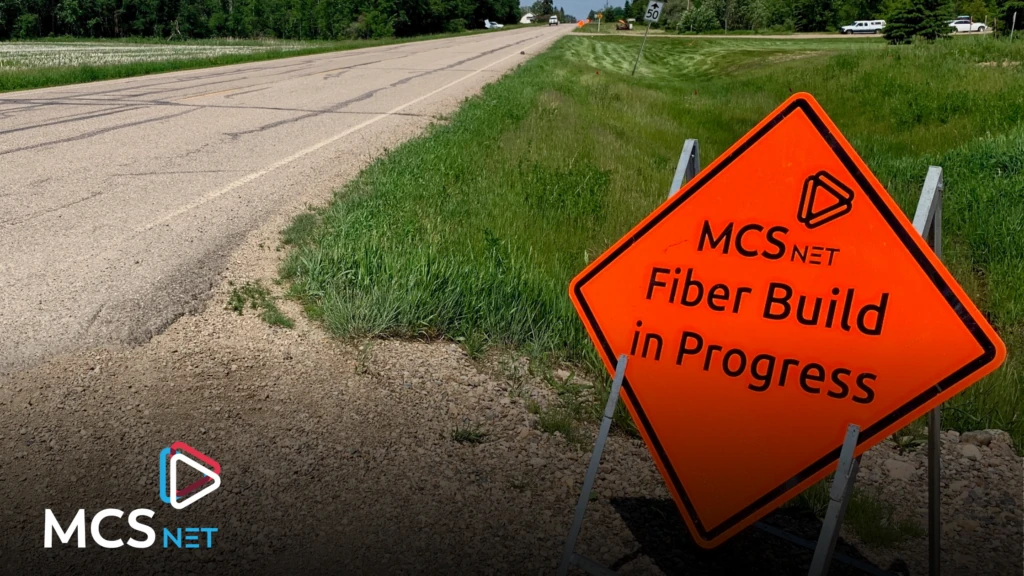
On July 24, 2026, the Honourable Buckley Belanger, Secretary of State for Rural Development, announced $2,812,842 in federal funding allocation for MCSnet. Supported by the Universal Broadband Fund, this grant will bring high-speed internet access to rural and remote areas in western Saskatchewan.
This initiative allows MCSnet to expand its high-speed internet footprint into Saskatchewan. By deploying transit fiber directly to towers in rural communities, the project ensures local residents will have access to reliable, fast internet services.
The specific communities within the MCSnet service area that will benefit include Lashburn, Maidstone, Waseca, Greenstreet, Hillmond, and surrounding areas. While MCSnet has served some of these locations for years, constructing a fiber optic backbone to these Saskatchewan towers and linking them to its larger, privately-owned network will make internet connections much stronger and faster.
“MCSnet’s Fiber-to-the-Tower expansion will deliver fast, highly reliable internet access to underserved homes in rural Saskatchewan, courtesy of a dedicated, community-invested provider. As a family-owned company, based on the prairies, we have been serving rural communities with our innovative technology and exceptional customer service for over 30 years.” – Jerome VanBrabant, Chief Projects Officer, MCSnet
Project plans are already underway with fiber and tower construction expected later in 2026.
Key Highlights
- MCSnet will connect up to 1,145 underserved households with high speed internet access.
- These connections will facilitate local business growth and increase property values.
- MCSnet remains locally owned and operated in St. Paul, Alberta.
- The Universal Broadband Fund is a $3.225 billion investment by the Government of Canada designed to help provide high-speed Internet access to 98% of Canadian households by the end of 2026 and achieve the national target of 100% access by 2030.
- Since 2015, the Government of Canada has invested more than $550 million in connectivity projects in Alberta.
Associated Links
- Government of Canada Announces Recipients for Saskatchewan UBF
- Grant Recipents Backgrounder
- Universal Broadband Fund Webpage
- High-speed internet for all Canadians
The post MCSnet expands into Saskatchewan with Fiber-to-the-Tower UBF Grant Projects appeared first on MCSnet.
]]>TL;DR Moving homes comes with a long checklist. The Internet should be on it earlier than most people think. A lot of homeowners wait until the last minute to figure it out, only to realize that their new property needs installation, equipment placement, or a different plan than the one they had before. That can […]
The post Guide to Internet Installation When Moving to Rural Alberta appeared first on MCSnet.
]]>
TL;DR
- Check your new address first to see what internet is actually available.
- Book installation 2 to 3 weeks before moving day to avoid delays.
- Plan for your home Wi-Fi setup, especially in larger homes or acreages.
- If you choose MCSnet, check whether you need a new install, transfer, or move of service.
- Check MCSnet availability at your new address and contact customer service early to get started.
Moving homes comes with a long checklist. The Internet should be on it earlier than most people think.
A lot of homeowners wait until the last minute to figure it out, only to realize that their new property needs installation, equipment placement, or a different plan than the one they had before. That can leave you spending your first days in the new home with weak Wi-Fi, delayed setup, or no connection at all.
The good news is that internet installation when moving does not have to be stressful. With the right steps, you can make the process much smoother and choose a setup that actually fits your new home.
This guide provides your internet installation checklists and things to consider when moving.
Check Your New Address First
Before you compare plans or think about promotions, start with the most important question: What internet service is actually available at my new address?
This matters because not every home has the same setup or service options. A provider may serve the wider area, but your exact address may have different availability depending on the property, existing equipment, or what infrastructure is already in place.
When checking your new address, make sure you confirm:
- Whether service is available now
- Whether installation is required
- What kind of setup does the home need
- What types of internet technology is available to your new address
- Whether the service is a good fit for how your household uses the internet
This one step saves time and helps you avoid comparing plans that will not work at your new location.
Assess Your Household’s Real Internet Needs

Moving is a good time to rethink your internet needs instead of just repeating your old setup.
The plan that worked in your old house may not be the right one for the new place. A larger home, more connected devices, remote work, streaming, gaming, smart home devices, or a detached building can all change what kind of plan, service and home network setup make sense.
Before choosing a plan, ask yourself:
- How many people will be online at the same time?
- Does anyone work from home?
- Do you stream TV regularly?
- Are there gamers in the house?
- Do you use security cameras or smart devices?
- Will Wi-Fi need to reach multiple floors, outbuildings, or distant rooms?
This helps you choose internet based on real use, not guesswork.
Book Early and Avoid Last-Minute Setup Problems
One of the biggest moving mistakes is leaving the internet too late.
Try to arrange service two to three weeks before your move date. That gives you time to confirm availability, choose the right package, and secure an installation appointment that fits your moving timeline.
Booking early helps because:
- Installation windows may fill up
- Some homes need a more involved setup
- You may need to prepare the home before the technician arrives
- Moving day is already busy enough without adding internet delays
The goal is simple: have the process lined up before move-in so you can settle in faster.
Ways to Optimize or Troubleshoot Your Home Network After Moving
A few simple changes can make a big difference:
- Place the router centrally
- Restart all devices after move-in
- Test speeds in different rooms
- Use wired connections for the most important devices
- reduce interference from walls, metal, and appliances
- Use Mesh Wi-Fi systems for larger homes
If the connection feels weak after installation, rule out in-home Wi-Fi issues before assuming the internet plan itself is the problem.
Choosing MCSnet: What You Should Know
If you are considering MCSnet for your new home, or you are already with MCSnet and want to move your service, there are a few practical things worth knowing before moving day.
First, check availability at the new address
Clicking on our Check Availability tool the first step. MCSnet offers different service types depending on location, and not every address will qualify for the same setup. For wireless and GigAir service, good line of sight to an MCSnet tower is required. Fiber services are different and do not rely on that same requirement.
Understand the difference between a transfer and a move
If you are moving into a residence that already has active MCSnet equipment or service in place, that is treated as a transfer of services. In that case, the goal is to connect the new occupant to the existing setup at the property. MCSnet may request documentation, especially if there is an outstanding balance connected to the current resident.
If you are already an MCSnet customer and relocating your current account to a completely new home, that is treated as a move of services. In that case, your account needs to be in good standing and MCSnet coordinates the install at the new address and the service change from the old one.
Know the contract and installation choices
MCSnet currently offers two standard installation options:
- 2-year term with free standard installation
- month-to-month with a $199.95 standard install fee, charged on the first invoice
For the 2-year term, if services are moved or cancelled before the full term is complete, a prorated cancellation fee applies, calculated at $8.33 per month remaining.
For movers, this is important because it helps you decide whether you want a lower upfront cost or more flexibility.
Always check to see the MCSnet promo that is ongoing, as that can save you money on plans and installation costs.
You can change your package later if needed
A move often changes how a household uses the internet. MCSnet customers can change their package to suit their needs, and there are no overage charges.
Instead, customers receive email notices at 75% and 90% of their data use. If they reach the cap, they can either upgrade or continue in Unlimited Mode at a reduced speed. Package upgrades stay in place for 30 days, after which customers can contact MCSnet to downgrade if they choose.
That flexibility is useful if you are not yet sure what the new home will require.
Router options are part of the move decision
MCSnet gives customers the option to rent an MCSnet router for $4.95 + tax per month.
The MCSnet router remains MCSnet property and includes ongoing replacement warranty coverage for as long as the router rental stays active. MCSnet routers are customized for its services and include live traffic and Wi-Fi device monitoring through the MCSnet app or MyAccount.
This matters when moving because the new home may need better Wi-Fi visibility or a different router setup than the old one.
There are a few extras to know about
MCSnet also offers:
- VoIP home phone for $29.95/month
- A referral program, where both the new customer and the referrer can receive a $50 credit
- Park Mode for seasonal properties at $19.95 + tax per month, which keeps the connection parked at the location without full cancellation, though service cannot be used while parked
How to Get MCSnet at Your New Home

If you are moving and want to set up MCSnet, the most practical process is:
Check availability at your exact new address.
You can also get in touch with our Customer Service Reps for assistance.
- Toll Free: 1-866-390-3928
- Email: customerservice@mcsnet.ca
To learn more about what to consider when shopping for internet services in Rural Alberta, read our blog on Internet Buyer’s Guide for Rural Alberta.
Make Our Website Your Preferred Source on Google
If you find this blog helpful, please add our website to your Preferred Sources on Google to get recommendations from our blog the next time you are searching for internet-related solutions.
- Click this link: Add to Preferred Sources
- Type Mcsnet in the search bar, and check off MCSnet.
Frequently Asked Questions
How early should I book internet installation before moving?
A good target is two to three weeks before your move date. That gives you enough time to check service, choose a plan, and schedule installation without rushing.
What is the first step when setting up internet in a new home?
The first step is checking your exact new address. That helps confirm what service is available and whether installation is required.
What should I ask before booking internet at a new address?
Ask about availability, installation timing, contract options, setup fees, router choices, and what kind of equipment the property may need.
Can I move my current MCSnet service to a new home?
Yes, in some cases. If you are already with MCSnet, first confirm availability at the new address, then contact customer service to determine whether your situation is a move of services or a transfer of services.
What is the difference between a transfer and a move of services?
A transfer happens when you move into a home that already has MCSnet service or equipment in place. A move of services is when your existing MCSnet account is relocated to a brand-new address.
Does MCSnet offer month-to-month internet?
Yes. MCSnet offers a month-to-month standard install option with a $199.95 installation fee, as well as a 2-year term with free standard installation.
Can I change my MCSnet package after I move in?
Yes. MCSnet customers can change their monthly package to suit their needs. Upgrades are locked for 30 days, after which customers can contact MCSnet to downgrade if they choose.
The post Guide to Internet Installation When Moving to Rural Alberta appeared first on MCSnet.
]]>In today’s digital-first economy, an internet connection is no longer just a basic utility; it is the central nervous system of any successful business. Whether you are running a large-scale agricultural operation, a local hotel, or a logistics fleet, your connectivity dictates your efficiency. For businesses operating outside of major urban centers, accessing enterprise-grade internet […]
The post The Digital Lifeline: Why High-Speed Internet is Vital for Rural Businesses appeared first on MCSnet.
]]>
In today’s digital-first economy, an internet connection is no longer just a basic utility; it is the central nervous system of any successful business.
Whether you are running a large-scale agricultural operation, a local hotel, or a logistics fleet, your connectivity dictates your efficiency.
For businesses operating outside of major urban centers, accessing enterprise-grade internet has traditionally been an uphill battle. The complexities of rural geography often mean that the standard solutions provided by major telecommunications companies simply don’t bridge the gap.
If you are searching for the right business internet in rural Alberta, the decision is not just about the cheapest monthly rate; there are other key factors to consider. To understand what is at stake, we must first look at the three foundational pillars that high-speed business internet provides and then examine why finding the right local partner makes all the difference.
The Three Pillars of Modern Business Connectivity
Upgrading to a high-speed, reliable network directly impacts a company’s bottom line through three core benefits:
- Saving Time: It is a universal business truth that a slow internet connection results in everything taking more time, and time is money. With high-speed internet, staff can carry out their daily digital tasks almost instantly, eliminating bottlenecks and allowing them to move quickly to the next job.
- Collaborating Better: Modern businesses run on cloud software and shared files. High-speed internet allows for improved access to shared platforms, the prompt transfer of information, and swift file sharing. When employees and customers can communicate and collaborate efficiently without lag, it translates directly into revenue growth.
- Reliability and Security: Unreliable internet connections carry real, measurable costs. Even minor unplanned downtime can bring productivity and communication to a complete halt. A secure and reliable connection ensures that a business is always online, protecting operations from costly interruptions.
The Rural Disconnect
While urban businesses take these three pillars for granted, rural enterprises often struggle to attain them.
Traditional fiber-optic cables can be prohibitively expensive or physically impossible to trench across vast rural distances or through certain terrains.
Furthermore, national providers often lack the localized support infrastructure required to quickly address outages in remote areas, leaving businesses waiting days for critical repairs.
The MCSnet Difference: Engineered for Rural Alberta
This is where a specialized, local approach becomes essential. MCSnet is built specifically to address the unique complexities of rural business internet. We recognize that rural businesses need the exact same high-performance connectivity as their urban counterparts, but delivered through innovative methods and backed by localized support.
Here is how MCSnet stands apart in the rural market:
- Fiber Speeds Without the Digging: For towns, hamlets, and industrial parks where trenching fiber isn’t feasible, MCSnet offers GigAir. This new form of wireless technology provides gigabit speeds that match fiber-optic internet, but with a quick, non-invasive installation that doesn’t require digging up the ground.
- Unmatched, Localized Support: When downtime costs money, waiting on hold with a national call center isn’t an option. MCSnet provides a dedicated support line for all corporate plans, offering around-the-clock technical support and same-business-day onsite repairs to ensure you don’t experience lengthy interruptions. Our neighbourly team is based right here in St. Paul, Alberta.
- Tailored, Dedicated Connections: Unlike residential networks where bandwidth is shared, our corporate fiber and dedicated point-to-point connections are fully dedicated to your business. Corporate plans also offer up to 10 static IP addresses and Service Level Agreements (SLAs) with a 99.9% uptime guarantee for peace of mind.
- A Community-Minded Partner: We believe in growing the regions we serve. As Darren Wiebe, IT Manager at Horizon Ag and Turf notes, “It’s a privilege to deal with a well-respected local company that understands our needs”. We actively partner with local municipalities, such as the County of St. Paul, to install towers and expand fiber networks into underserved areas.
Types of Businesses Relying on MCSnet Business Internet For Smooth Operations
MCSnet supports a wide range of businesses, public organizations, and community institutions across rural and regional Alberta. These customers reflect the diversity of the communities MCSnet serves.
Agriculture and Heavy Equipment
Agricultural businesses depend on reliable internet to manage equipment, inventory, logistics, customer communication, and day-to-day operations. MCSnet supports farms, agricultural suppliers, machinery dealerships, grain companies, crop operations, and local co-operatives.
Automotive and Mechanical Services
Automotive and mechanical businesses use dependable internet to support bookings, diagnostics, payments, parts ordering, customer service, and internal systems. This includes repair shops, tire shops, dealerships, and other vehicle service providers.
Oil, Gas, and Industrial Operations
Industrial businesses often need strong, dedicated connections for remote sites, field operations, data systems, security, and communication. MCSnet supports companies in oil and gas, pipeline services, manufacturing, recycling, transportation, and other industrial sectors.
Municipalities and Public Services
Municipalities and public organizations rely on internet to manage administration, public works, utilities, emergency services, community facilities, and public communication. MCSnet supports local governments, public service facilities, emergency response operations, and critical infrastructure.
Healthcare and Wellness
Healthcare and wellness providers need secure, reliable connectivity for scheduling, records, communication, billing, and patient or client services. MCSnet supports pharmacies, clinics, diagnostic services, veterinary practices, care facilities, and wellness organizations.
Hospitality and Housing
Hotels, motels, campgrounds, lodges, and housing organizations need internet to support guests, residents, bookings, payments, operations, and administration. MCSnet helps these organizations stay connected and provide better service.
Professional Services
Professional offices depend on internet for client communication, file sharing, cloud software, secure systems, and daily administration. MCSnet supports law offices, accounting firms, registries, insurance offices, consultants, and other professional service providers.
Retail and Consumer Goods
Retail businesses need reliable internet for point-of-sale systems, inventory management, online orders, customer communication, and payment processing. MCSnet supports grocery stores, pharmacies, hardware stores, convenience retailers, and other local shops.
Education and Learning
Schools and education-focused organizations rely on strong connectivity for learning tools, administration, communication, and online resources. MCSnet supports schools, education divisions, training centres, and learning facilities across rural communities.
Media, Recreation, and Community Spaces
Media companies, recreation facilities, golf courses, cultural spaces, and community venues all need internet to operate smoothly, serve visitors, and manage events. MCSnet supports organizations that help keep rural communities active, informed, and connected.
How MCSnet Supports Municipalities and Governments
Municipalities and government organizations rely on reliable internet to manage essential services, infrastructure, public safety, and community operations. MCSnet supports these needs through reliable rural business internet and local infrastructure partnerships.
- Essential Infrastructure and Public Safety: MCSnet provides dedicated connections for utilities, emergency services, public safety operations, and critical community infrastructure.
- Administrative and Public Works Facilities: MCSnet supports municipal offices, public works shops, operations centres, transportation facilities, and visitor information spaces with reliable business internet.
- Consolidated Communications: MCSnet helps local governments combine internet and corporate phone services to keep departments, staff, and service teams connected.
- Community Connectivity: MCSnet partners with municipalities to expand internet access in underserved areas and support public Wi-Fi in community spaces.
- Infrastructure Collaboration: MCSnet works with local governments on tower sites, co-location opportunities, and shared infrastructure that help improve rural connectivity.
Powering Small and Medium-Sized Businesses
Small and medium-sized businesses are the backbone of rural and regional communities. From local shops and trades to agricultural operations, service providers, hospitality businesses, and professional offices, these organizations depend on reliable internet to keep their daily operations moving.
MCSnet supports SMBs with business internet solutions that help them manage payments, bookings, customer communication, inventory, online tools, security systems, and cloud-based software. Whether a business is serving local residents, visitors, suppliers, or remote teams, dependable connectivity helps reduce downtime and improve efficiency.
Across northeastern and central Alberta, and into nearby Saskatchewan border communities, MCSnet helps rural and urban businesses access the speed and reliability they need to compete, grow, and serve their customers with confidence.
Supporting Local Organizations and Community Hubs
MCSnet also plays an important role in connecting the organizations that bring rural communities together. This includes agricultural societies, community halls, cultural associations, recreation spaces, daycares, campgrounds, and other local gathering places.
These organizations rely on internet to manage events, coordinate volunteers, communicate with families, process bookings, support visitors, and keep community programs running smoothly.
By providing reliable connectivity to these local hubs, MCSnet helps strengthen the places where people gather, learn, celebrate, work, and connect. It is one more way MCSnet supports the communities it serves beyond business alone.
Connect With a Provider Who Understands
Your business deserves an internet provider that views rural geography as a landscape of opportunity, not an inconvenience.
If you are ready to upgrade your operations, our Business Advisors will work with you to deliver the best internet services available to your specific area. Call us toll-free at 1-866-390-3928 ext. 1 or email corporate@mcsnet.ca to get started today.
The post The Digital Lifeline: Why High-Speed Internet is Vital for Rural Businesses appeared first on MCSnet.
]]>When dealing with slow internet, buffering, lag, or Wi-Fi that feels overloaded, most people assume the problem is always internet speed. Sometimes it is. But just as often, the issue can be bandwidth or the way your household is sharing the connection across multiple devices. Understanding the difference between internet speed and bandwidth can help […]
The post Internet Speed vs. Bandwidth: What It Means And How It Affects Your Connection appeared first on MCSnet.
]]>
When dealing with slow internet, buffering, lag, or Wi-Fi that feels overloaded, most people assume the problem is always internet speed. Sometimes it is. But just as often, the issue can be bandwidth or the way your household is sharing the connection across multiple devices.
Understanding the difference between internet speed and bandwidth can help you make smarter decisions about your home network and plans. It can also help you compare options like fixed wireless, fiber, and satellite more clearly.
The Canadian Radio-television and Telecommunications Commission universal service objective remains 50 Mbps download, 10 Mbps upload, and unlimited data, while Alberta continues to expand high-speed access in rural areas, where connection types can still vary widely by property.
This article provides a guide to understanding internet speed vs bandwidth and how that affects your everyday connection.
What Is Bandwidth: The Highway To Your Home
The easiest way to understand bandwidth is to think of it as capacity. Bandwidth is the amount of data your connection can carry at the same time. In simple terms, it is the size of the pipeline between your home and the internet.
A common way to picture this is the highway analogy. If your internet connection is a highway, bandwidth is the number of lanes. A wider highway can handle more vehicles at once. In the same way, a connection with more bandwidth can handle more devices, streams, uploads, and downloads at the same time without becoming crowded.
That is why bandwidth matters so much in real life. A home with one person checking email and browsing the web does not need the same capacity as a home where one person is streaming in 4K, another is on a work VPN, someone else is gaming, and a few smart devices are also connected in the background.
The problem in that second scenario is not always that the internet is “slow.” It may be that too many activities are trying to use the available capacity at once.
What Is Internet Speed? The Speed Limit Of Your Data
Internet speed is different. It refers to how fast data moves across that connection. It is usually measured in Megabits per second (Mbps). You will often see two numbers: download speed and upload speed.
Download speed affects how quickly you can receive data from the internet. That matters for streaming, browsing, loading websites, and downloading files. Upload speed affects how quickly you can send data out, which matters for video calls, uploading photos and videos, cloud backups, and sending large files.
Going back to the highway example, if bandwidth is the number of lanes, internet speed is the speed limit on those lanes. A road with a high speed limit can move traffic faster, but if there are not enough lanes, traffic can still pile up. In the same way, a fast internet plan can still feel strained when too many devices are competing for the same connection at once.
Why Bandwidth Is Important For Rural Alberta Homes. Not Just Speed
In many households, the internet is no longer used by one computer at a time. It supports TVs, phones, tablets, laptops, gaming consoles, smart speakers, cameras, and work devices all at once. Even if the plan’s top speed looks fine on paper, the connection can still feel crowded if the available capacity is being shared across too many devices.
That is why households often say they have a “slow internet connection” when what they are really experiencing is congestion inside the home. The connection may have enough raw speed for one or two activities, but not enough room for everything happening at once.
This matters even more in rural Wi-Fi environments where the connection is already being stretched across larger properties or multiple users.
How To Check Your Internet Speed

If your connection feels weak, the first step is to test it properly. A speed test can show how much download speed, upload speed, and latency you are actually getting. These can help you determine where your internet performance problem is coming from.
For rural Alberta households, there are various tools that measure internet performance in real network conditions. These tools can test not just speed, but also quality indicators that help explain why the internet might feel poor even when a basic speed number looks acceptable.
When you test your connection, it helps to:
- Run the test more than once
- Test at different times of day
- Test near the router and farther away
- Pause heavy downloads or streaming before testing
- Compare Wi-Fi results with a wired connection if possible.
Read our blog on How to Test Internet Speed, to learn more. For users who prefer tools like Ookla, read our blog on A Guide to Internet Speed Tests With Ookla (speedtest.net).
If the results are consistently much lower than expected, the issue could be the plan, the in-home network, or the connection type available at your property.
How Internet Service Providers Impact Bandwidth
Internet Service Providers (ISPs) play a critical role in bandwidth by building and managing the infrastructure that delivers capacity to your home. For example, ISPs in rural areas deploy various technologies like fiber, fixed wireless, and satellite, and the type of connection available at your property dictates your potential bandwidth.
Key ways ISPs impact bandwidth:
- Capacity Expansion: Providers like MCSnet actively invest in and build infrastructure, such as laying fiber optic cable between towers, specifically to increase the overall broadband capacity of their fixed wireless network and offer enhanced services.
- Bridging the Digital Divide: ISPs secure grants, like the Universal Broadband Fund (UBF), to fund large fiber optic projects that improve broadband access, which in turn provides higher capacity and reduces congestion in rural communities.
- Network Management and Allocation: ISPs must manage the available network resources. For instance, some providers must carefully allocate bandwidth, as removing data limits across the board could potentially undermine performance for all customers.
- Setting the Available Options: Ultimately, the customer must choose a plan and connection type offered by the ISP that matches their household’s real usage, device load, and location, making the ISP’s offerings the practical limit of available bandwidth.
The Customer’s Role in Maximizing Bandwidth
While your ISP handles the connection to your property, you have significant control over how bandwidth is used inside your home. By managing your local network and device settings, you can maximize the effective capacity you receive:
- Prioritize Wired Connections: For stationary devices like gaming consoles, smart TVs, and desktop computers, use an Ethernet cable where possible. Wi-Fi is inherently slower (on average 30% slower than a cabled connection) and prone to signal fluctuations, whereas a wired connection is faster, more reliable, and provides better latency.
- Extend Wi-Fi with Cabled Access Points: If you notice poor Wi-Fi signals in parts of your home, use additional cabled access points (like extra MCSnet routers) to extend the signal. These access points must be cabled to the original router.
- Manage Streaming Quality: Streaming services often default to an “Auto” setting, which can consume a high amount of bandwidth. Adjust the playback settings on streaming accounts through their respective apps or websites to conserve bandwidth, which can make up to a tenfold difference in traffic.
- Monitor Device Usage: Subscribers can utilize management tools to view bandwidth usage per device, see live and historical stats, and run speed tests. These features help you gain insight and control of your home network, cutting down on congestion.
Getting The Right Internet Plan For Your Property
You cannot always control every part of the network, especially in rural areas where geography and infrastructure play a bigger role. But you can make better decisions when you understand the difference between speed and bandwidth.
If one or two people in your home use the internet lightly, your needs may be simple. But if your household has multiple connected devices, streams video often, works from home, games, or relies on smart home tools, bandwidth becomes just as important as speed. That is when choosing the right rural internet plan starts to make a real difference in everyday performance.
The goal is not just faster internet on paper. It is a connection that fits the way your home actually lives online. MCSnet optimizes its privately-owned network by adding redundant 100 Gbps paths and diverse data centre locations. MCSnet has also invested millions of dollars locally to ensure your connections are optimized for speed and bandwidth.
Make Our Website Your Preferred Source on Google
If you find this blog helpful, please add our website to your Preferred Sources on Google to get recommendations from our blog the next time you are searching for internet-related solutions.
- Click this link: Add to Preferred Sources
- Type Mcsnet in the search bar, and check off MCSnet.
Frequently Asked Questions On Bandwidth vs Internet Speed
What is the difference between bandwidth and internet speed?
Bandwidth is the amount of data your connection can handle at one time. Internet speed is how fast data moves. A simple way to think about it is this: bandwidth is the number of lanes on the highway, and speed is how fast traffic moves in those lanes.
Why does my internet feel slow even when my speed test looks good?
If your speed test looks fine but your internet still feels slow, the issue may be bandwidth congestion in the home. Too many devices streaming, gaming, uploading, or using video calls at the same time can make the connection feel overloaded. It could also depend on your provider. If the network is crowded by users, your internet will slow down, unless network contingencies have been put in place.
Does more bandwidth mean faster internet?
Not exactly. More bandwidth means your connection can handle more activity at once. It does not automatically make one device faster, but it can improve the overall experience in homes with multiple connected devices. If your ISP has optimized its network traffic as MCSnet does, you should also notice a difference.
What causes buffering in homes?
Buffering can happen when your download speed is too low, when too many devices are using the connection at once, or when your Wi-Fi network is struggling to keep up. It could also be the host network or platform. The Sportsnet+ app while streaming is known for server issues.
How many connected devices can affect my internet?
Every connected device uses part of your available bandwidth. Smart TVs, phones, tablets, gaming consoles, security cameras, smart speakers, and laptops all add up, especially when several are active at the same time.
What is a good internet speed for a rural Alberta household?
That depends on how your household uses the internet. A smaller home with light browsing and email needs much less than a home with multiple people streaming, gaming, working from home, and using smart devices all at once. In Canada, the CRTC’s universal service objective remains 50 Mbps download, 10 Mbps upload. MCSnet averages 400 Mbps download across its network.
How can I test my internet speed?
You can use a speed test tool such as fast.com or speedtest.net to check your download speed, upload speed, and latency. It is best to test more than once, at different times of day, and both near your router and farther away in the home.
Can Wi-Fi make my internet feel slower?
Yes. Even if your internet plan is strong, poor router placement, interference, or distance from the router can make your Wi-Fi feel slower than it should.
What internet option is best for rural Alberta?
The best option depends on your location and what is available at your property.
When should I upgrade my internet plan?
It may be time to upgrade if you deal with regular buffering, dropped video calls, slow uploads, or too many devices competing for bandwidth at once. If your plan is limited by speed, you may need to upgrade to the next tier.
How do I choose the right internet plan for my property?
Start by thinking about how many people use the internet, how many devices are connected, what kinds of activities happen online, and whether your issue is speed, bandwidth, or both. Then compare plans based on what is actually available at your location.
The post Internet Speed vs. Bandwidth: What It Means And How It Affects Your Connection appeared first on MCSnet.
]]>When people shop for internet plans, they usually look at one number first: speed. But there are really two different speeds that matter: download speed and upload speed. Understanding the difference can help you choose the right internet plan, especially if your household does more than basic browsing. Streaming 4K movies, working from home, joining […]
The post Upload Speed vs. Download Speed: 2026 Guide and Full Breakdown appeared first on MCSnet.
]]>
When people shop for internet plans, they usually look at one number first: speed. But there are really two different speeds that matter: download speed and upload speed.
Understanding the difference can help you choose the right internet plan, especially if your household does more than basic browsing. Streaming 4K movies, working from home, joining Zoom calls, uploading files to the cloud, gaming, and running smart devices all place different demands on your connection.
This is one of the most common questions we hear from customers: Do I need more upload speed, more download speed, or both? This guide breaks it down in simple terms.
What is the Main Difference Between Upload Speed and Download Speed?
Download speed is how fast your internet connection can receive data from the internet to your device.
Upload speed is how fast your internet connection can send data from your device to the internet.
Both are measured in Mbps, which stands for megabits per second. The higher the Mbps, the more data your connection can move in a second.
Now let’s dive deeper into these types of speeds and what you need to know when making your choice.
What is Download Speed?
Download speed is the speed your connection uses to bring information to you. When you hit play on Netflix, open a website, or install a software update, your connection is downloading data. This is why download speed is usually the number people notice first.
Common Activities That Rely on Download Speed
The most common download-heavy activities include:
- streaming Netflix, YouTube, and other video platforms
- browsing websites
- loading apps and social media feeds
- downloading files, movies, and software updates
- streaming music
- online gaming downloads and patches
Video is one of the biggest drivers of data use and download demand. Netflix says recommended speeds are 3 Mbps for HD and 15 Mbps for 4K/Ultra HD streaming. Netflix also says 4K streaming can use up to 7 GB per hour. Read our blog on How Much Data and Internet Speed Streaming Platforms Use, to learn more.
What is a Good Download Speed?
A “good” download speed depends on how many people and devices are using the internet at the same time and what kind of activities they are using it for.
As a practical rule of thumb:
- 25+ Mbps can work for a light-use household with 1 or 2 users
- 50+ Mbps is better for a slightly bigger household with HD streaming, remote work, and a few connected devices
- 100+ Mbps is a strong fit for larger households, multiple simultaneous streams, and heavier daily use
- Higher speeds make even more sense for households doing 4K streaming, game downloads, and lots of connected-device activity
The Federal Communications Commission of the United States household guide shows that speed needs rise quickly as device counts and simultaneous use increase. For a practical plan comparison and guide on how much internet download speed you need for common activities, see MCSnet’s 2026 Internet Buyer’s Guide.
What is Upload Speed?
Upload speed is the speed your connection uses to send information from you to the internet.
If you upload a video to the cloud, share a large file, turn on your camera for a work call, or back up your phone photos, you are using upload speed.
Common Activities That Rely on Upload Speed
The most common upload-heavy activities include:
- Zoom and Teams video calls
- uploading large files to Google Drive, Dropbox, or OneDrive
- sending large email attachments
- cloud backups
- posting videos to social media
- livestreaming
- online gaming voice chat and cloud syncing
- security cameras sending footage to the cloud.
Zoom’s official guidance shows that even standard video calls need steady upload capacity. For example, 1:1 HD video can need about 1.2 Mbps up, while 1080p calls can need 3.0 Mbps up. Group HD calls can also require more.
What is a Good Upload Speed?
According to this SpeedTestNet article, for many homes, 10 Mbps upload is a good starting point for smoother remote work, file sharing, and video calls. But the real answer depends on what you upload and how many people are doing it at once.
If your household works from home often, upload speed matters much more than many people expect. For rural households, this is especially important when multiple people are online at once. You can also compare options in MCSnet’s rural internet plans in Alberta. For a guide on how much internet upload speed you need for common activities, see MCSnet’s 2026 Internet Buyer’s Guide.
Upload Speed vs. Download Speed: Key Differences
Here is the simplest way to compare upload vs download speed:
| Factor | Download Speed | Upload Speed |
| Direction | Internet to your device | Your device to the internet |
| Main use | Streaming, browsing, downloading | Video calls, uploads, backups, livestreaming |
| Typical priority for most homes | Higher | Lower |
| Impact if slow | Buffering, slow downloads, laggy streaming | Frozen Zoom calls, slow file uploads, poor livestream quality |
| Who needs more | Streamers, large households, frequent downloaders | Remote workers, creators, gamers with voice chat, cloud-heavy users |
| Typical setup on many plans | Faster than upload | Slower than download |
Quick Summary: Does Upload or Download Speed Matter More?
For most households, download speed matters more because most people spend more time consuming content than creating it. Streaming, browsing, and downloading all rely heavily on download speed.
But upload speed becomes much more important if you:
- work from home
- make frequent video calls
- upload large files
- use cloud storage often
- stream live content
- have security cameras or other smart devices sending data out
A simple way to think about it:
- Download speed = best for watching, browsing, streaming, and downloading.
- Upload speed = best for working, calling, sharing, backing up, and creating.
What Internet Usage Category Does Your Household Fall Under?
The best internet speed for your home depends on how you actually use the internet, not just the biggest speed number on the page. See an example of a household usage categorization:
Light Usage
Light usage usually includes:
- web browsing
- online banking
- music streaming
- social media
- occasional video streaming
For this type of use, you may not need extremely high speeds. A lower-speed plan can still work well if only one or two people are online and the household is not doing much HD or 4K streaming at the same time.
Moderate Usage
Moderate usage often includes:
- HD streaming
- remote work
- Zoom or Teams meetings
- multiple phones and laptops
- smart TVs
- occasional gaming
This is where many modern households land. In this range, both download and upload speed start to matter more.
Heavy Usage
Heavy usage often includes:
- multiple 4K streams
- frequent game downloads and updates
- livestreaming
- large cloud backups
- security cameras
- several users online at once
If your home fits this category, slower upload speeds can become a bottleneck even if your download speeds look fine on paper. A faster plan, and ideally one with stronger upload speed, usually creates a noticeably better experience.
For a practical plan comparison and guide on how much upload and download internet speed you need for common activities, see MCSnet’s 2026 Internet Buyer’s Guide.
For a related read, see MCSnet’s guide on how much data and internet speed streaming platforms use.
Asymmetrical Internet Plans: Why is My Upload Speed Slower Than My Download Speed?
Many internet plans are asymmetrical, which means download speeds are higher than upload speeds.
This is common because the average household usually downloads far more than it uploads. People stream, browse, and download more often than they upload large files. Business internet and fiber services are more likely to offer near-symmetrical or symmetrical performance.
That is why you might see an internet plan advertised with very strong download speeds, but much lower upload speeds.
When Do Symmetrical Speeds Matter
Symmetrical internet speeds mean your upload and download speeds are the same, such as 100/100 Mbps or 1 Gbps/1 Gbps.
This matters most for people who do a lot of sending as well as receiving, including:
- content creators
- remote teams
- businesses
- streamers
- households that upload large files often
- homes with multiple cloud-connected cameras
- people backing up large amounts of data regularly
If your home mostly streams and browses, symmetrical speeds may not be essential. But if your household creates, uploads, shares, and collaborates online every day, symmetrical internet speeds can make a difference.
How to Test Your Current Internet Speeds
The easiest way to check your current connection is to run a speed test.
Popular tools include:
- Speedtest by Ookla
- Fast.com
- Your internet provider may have its own test tool.
- For MCSnet users, you can Test Your Internet Speed and learn more about your speed here.
Fast.com is run by Netflix and focuses on download speed first, while also offering upload and latency testing. Netflix says it is designed to be a quick way to estimate the speed your ISP is delivering.
For the most useful result:
- test on a wired connection if possible
- pause downloads and streaming before testing
- run the test more than once
- test at different times of day
- compare results in the same room and farther from your router.
If you want to learn more about speed tests and how to properly do an internet speed test for more accurate results, read the MCSnet blog on How to Test Internet Speed. To learn more about how to do a speed test, using Ookla, read the MCSnet Guide to Internet Speed Tests With Ookla (speedtest.net).
How to Increase Your Upload and Download Speeds
Sometimes the issue is not the plan itself. Your setup can also affect performance.
Use a Wired Ethernet Connection
A wired Ethernet connection is usually more stable than Wi-Fi and can help reduce speed loss, interference, and latency. Zoom specifically recommends switching to a wired connection when Wi-Fi performance is poor.
Improve Router Placement
Router placement matters more than many people think. In general, it helps to place your router in a central location, off the floor, away from thick walls, away from metal objects and away from appliances that may cause interference. A better router location can improve coverage and consistency across the home.
Close Bandwidth-Heavy Applications
Background downloads, cloud sync tools, large updates, streaming apps, and many open devices can all compete for bandwidth. Closing or pausing them before important calls or uploads can help.
You may also want to restart your router, update your router firmware, reduce the number of devices using the network at once, check for device or app updates running in the background and review whether your current plan still matches your household usage.
Learn more about Connection Troubleshooting using MCSnet or the MCSnet router.
To learn more about the MCSnet internet plans best for your household, visit our Internet Plans.
Conclusion: Choosing the Right Internet Plan
When comparing internet plans, do not focus only on the biggest download number.
Instead, ask:
- Do we mostly consume content, like streaming and browsing?
- Or do we also create, upload, call, back up, and work from home?
If your household mainly watches, scrolls, and downloads, download speed will matter most. If your household regularly sends files, joins video meetings, uploads content, or needs better two-way performance, upload speed becomes much more important.
The best plan is the one that matches the way your household actually uses the internet.
For more help learning about internet upload and download speeds and choosing the right fit, explore:
- MCSnet 2026 Internet Buyer’s Guide
- Rural Internet Plans Alberta
- How Much Data and Internet Speed Do Streaming Platforms Use?
Frequently Asked Questions
What is more important: upload or download speed?
It depends on what you do online. Download matters more for streaming and browsing. Decent upload speed matters more for video calls, file sharing, and cloud backups.
What is a good download speed for a home?
For most households that are light to moderate users, 25 to 100 Mbps is enough for everyday use. Larger households or homes streaming in 4K may need more.
What is a good upload speed for working from home?
A good starting point is 10 Mbps upload. More is better if you do frequent video calls, upload large files, or have multiple people working from home.
Do I need a fast upload speed for Zoom or Teams?
Yes. Video calls use both upload and download speed. A weak upload speed can cause freezing, lag, or poor video quality.
Is 25 Mbps fast enough?
It can be for light use, like browsing, email, and one or two streams. It may not be enough for larger households or heavier use.
Is 100 Mbps enough for Netflix and streaming?
Yes, for many households it is. It is usually enough for multiple HD streams and regular daily use, depending on how many people are online.
Does 4K streaming need more speed?
Yes. 4K streaming uses much more bandwidth than HD, so faster download speeds help prevent buffering.
Does upload speed matter for gaming?
Yes, but usually less than download speed and latency. Upload matters more for voice chat, livestreaming, and sending game data.
Why is my internet fast for downloads but slow on video calls?
Your plan may have a much lower upload speed than download speed. Wi-Fi issues can also affect call quality.
Why is my upload speed lower than my download speed?
Many internet plans are built that way. Most households download more than they upload, so providers often prioritize download speed.
Do I need symmetrical internet speeds?
Not always. They are most helpful for creators, remote workers, businesses, and households that upload a lot of data.
Does Wi-Fi affect my speed test results?
Yes. Wi-Fi can be slower than a wired connection, especially if you are far from the router or dealing with interference.
Will a better router improve my speeds?
It can improve Wi-Fi performance, coverage, and consistency. But it will not increase your plan’s maximum speed beyond what your provider delivers.
Why does my speed change during the day?
Speeds can vary based on network traffic, Wi-Fi conditions, device activity, and the number of people online at the same time.
How do I know if I need a faster plan?
If you deal with buffering, slow downloads, poor video calls, or multiple people competing for bandwidth, it may be time to upgrade.
The post Upload Speed vs. Download Speed: 2026 Guide and Full Breakdown appeared first on MCSnet.
]]>Do you use video streaming platforms like Netflix, and how often? Do you do any online gaming? Are you a basic internet user? These are just some of the questions we ask customers when they call in to sign up for internet services. For instance, if a family of four is signing up for MCSnet […]
The post How Much Internet Do I Need? appeared first on MCSnet.
]]>
Do you use video streaming platforms like Netflix, and how often? Do you do any online gaming? Are you a basic internet user? These are just some of the questions we ask customers when they call in to sign up for internet services.
For instance, if a family of four is signing up for MCSnet services and they each have a phone and/or tablet, they all want to stream Netflix on their smart TV or through their gaming console, and a couple of them want to do some online gaming, we would most likely suggest our Extreme to Unlimited package which provides enough traffic month to cover heavy usage. However, our recommendation may defer if it’s a household with low internet data usage.
According to the Canadian Radio-television and Telecommunications Commission (CRTC), data consumption among residential high-speed internet subscribers has increased substantially in recent years, with the average downloaded data per month per subscription in 2025 being estimated to be over 500 GB, a 126% increase from 2019. This means that the average internet data usage has significantly increased, and households need internet plans and offerings that take this into account.
Internet Data Consumers In Households
The biggest data hogs are streaming videos and downloading video games, movies, or software updates. Netflix alone can use up to 7 GB of data per hour if you are watching in Ultra HD. And one video game download can eat up to 50 GB of your monthly traffic limit.
Video Streaming
GlobalWebIndex reports that 92 percent of internet users now watch videos online each month, meaning that more than four billion people around the world are consuming online video content almost daily.
Streaming platforms like Netflix have accounted for heavy video streaming in households, and Netflix data usage varies significantly based on resolution, with high-definition (HD) streaming consuming roughly 3 GB per hour, while 4K Ultra HD can consume up to 7 GB per hour. Standard Definition (SD) is much more efficient, using around 0.7 GB to 1 GB per hour.
Here is a chart outlining estimated monthly data usage based on streaming 2 hours a day for 30 days. This includes one user and doesn’t take into account the amount of data the other members of your household are using.
Netflix Monthly Data Usage Chart (2 Hours/Day)
| Quality | Data per Hour | Estimated Monthly Data (60 Hours) |
| Low (Basic) | ~0.3 GB | ~18 GB |
| Medium (SD) | ~0.7 GB | ~42 GB |
| High (HD/1080p) | ~3.0 GB | ~180 GB |
| Ultra HD (4K) | ~7.0 GB | ~420 GB |
Netflix and other streaming apps do allow you to adjust playback settings. But with most televisions boasting HD and 4K definition resolution in their specs, many users prefer to watch movies and TV series at resolutions better than the standard definition.
Online Gaming
Online gaming typically consumes between 40 MB and 300 MB of data per hour, depending on the video game and the playback settings, this is according to Jetpac Global. This is significantly less than video streaming. Usage varies by game type; fast-paced shooters like Call of Duty take up to 160MB+, while slower, open-world, or mobile titles use less data, but increase with high player counts, high-tick-rate servers, and active voice chat.
Downloading a game is a different story. Since most games need to be downloaded, one game could use up to 50 GB in a single download. And remember that many of these games need to be updated as well, which is another download and more GB.
Smart Home
In smart homes, devices such as home security and whatever new technology comes our way contribute to the increasing need for data and reliable high-speed internet.
Smart home data usage varies significantly based on security camera usage, but generally ranges from 150 GB to over 700 GB+ per month for heavy users. While basic smart devices (lights, plugs) use minimal data, security cameras/doorbells can consume 30 – 400 GB, and 4K streaming adds a substantial load.
Basic Usage
A basic or light internet-using household that focuses on email, social media, bill payments, music streaming and web browsing typically uses less than 100 GB of data per month. For a single person who is an extremely light user, usage can be as low as 2 GB to 10 GB per month, according to a Consumer Cellular Blog Post.
Our Internet Data Usage and Packages Recommendations
If you don’t want to worry about traffic limits, unlimited packages are the way to go. The demand for unlimited internet packages is also on the rise and is one of the reasons why we offer this option. The percentage of subscriptions to internet service packages with unlimited monthly data transfer has significantly increased.
The infographic below explains some of the common uses and the packages we would most likely recommend to you. As with all of our packages, you can upgrade to a higher package at any time. You must remain on the upgraded package for 30 days before downgrading.
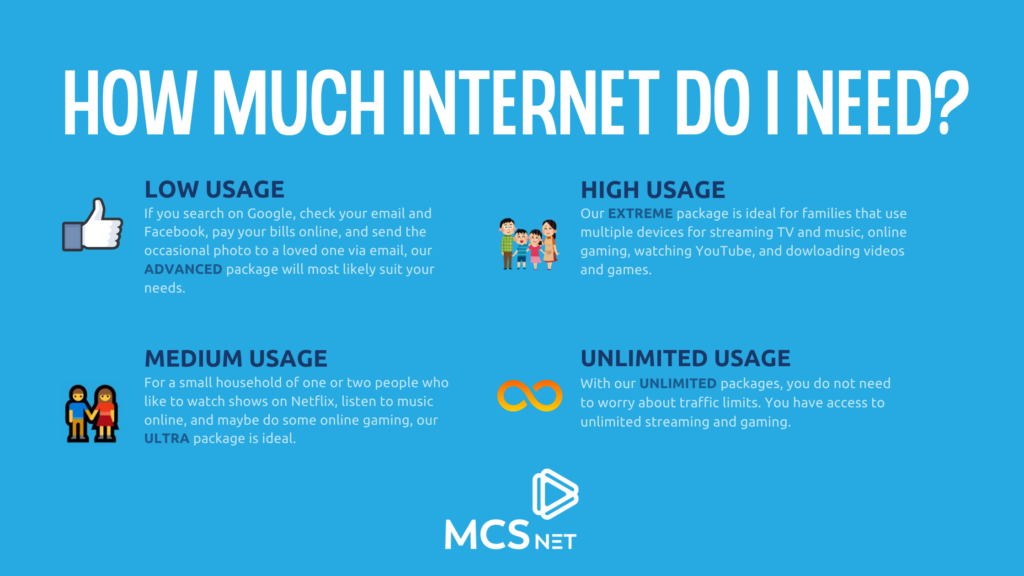
Common Internet Terms Explained
- GB (Gigabyte)
A gigabyte is a unit used to measure data. Internet usage is often measured in GB. The more videos you stream, games you download, or files you upload, the more GB you use. - MB (Megabyte)
A megabyte is smaller than a gigabyte. 1 GB = 1,000 MB in simple everyday usage. Small online activities may use MB, while larger ones are usually measured in GB. - Data Usage
This is the amount of internet data you use in a month through things like browsing, streaming, gaming, video calls, downloads, and smart devices. - Traffic Limit / Data Limit
This is the amount of data included in your internet package before overage rules, slowdowns, or plan limits may apply. - Unlimited Internet
An internet package that does not require you to worry about a set monthly data cap or traffic limit. - Streaming
Watching or listening to content online without downloading the entire file first. Examples include Netflix, YouTube, Spotify, and other video or music services. - SD (Standard Definition)
A lower video quality setting that uses less data than HD or 4K. - HD (High Definition)
A clearer and sharper video quality than SD, but it uses more data. - 4K / Ultra HD
A very high video resolution that looks sharper than HD but uses much more data. - Download
When data is transferred from the internet to your device. Downloading games, movies, updates, or large files can use a lot of data. - Upload
When data is sent from your device to the internet. Uploading videos, backing up files to the cloud, or sending large attachments all use upload data. - Bandwidth
Bandwidth is the amount of data your internet connection can handle at one time. More bandwidth can help households with many devices or people online at the same time. - Smart Home Devices
Internet-connected devices in your home, such as video doorbells, security cameras, smart thermostats, plugs, and smart speakers.
Frequently Asked Questions About Internet Usage
1. How do I know how much internet I need?
It depends on how many people are in your household, how many devices are connected, and what you do online. A person who mostly checks email, browses websites, and uses social media will need much less data than a family streaming TV, gaming, downloading large files, and using smart home devices.
2. What activities use the most internet data?
The biggest data users are usually video streaming, large downloads, video game downloads, software updates, and some smart home devices like security cameras. Streaming in HD or 4K can use a lot of data very quickly.
3. Does watching Netflix use a lot of data?
Yes. Netflix and other streaming platforms can use a significant amount of data, especially at higher picture quality settings. Netflix streaming ranges from about 0.3 GB per hour on low quality to 7 GB per hour on Ultra HD/4K.
4. Does video quality affect how much data I use?
Yes. The higher the video quality, the more data it uses. Standard Definition uses much less data than HD, and 4K uses the most. If you are trying to reduce data use, lowering your streaming quality can help.
5. Does online gaming use a lot of data?
Online gaming usually uses less data per hour than video streaming. However, downloading a game or installing updates can use a lot of data at once. That is why gamers may still need a larger package even if the gameplay itself does not use huge amounts of data.
6. Why do game downloads use so much data?
Many modern games are very large files. A single game download can use up to 50 GB, and updates can add even more. If more than one person in a household games regularly, data use can add up quickly.
7. Do smart home devices use a lot of internet?
Some do, some do not. Devices like smart plugs and lights usually use very little data. But smart security cameras, video doorbells, and heavy smart home setups can use much more, especially if they stream or store a lot of video.
8. Is a low-data internet package enough for one person?
It can be, depending on how they use the internet. A single light user who mainly browses the web, checks email, streams music, and uses social media may be fine with a lower-usage package. But if that person streams a lot of video, games, or works from home, they may need more.
9. What kind of household usually needs a higher data package?
A larger household with several connected devices, regular video streaming, online gaming, YouTube use, downloads, and smart devices will usually need a higher package. Families with heavier usage may be better suited to Extreme or Unlimited options.
10. Should I choose unlimited internet?
Unlimited internet is a good option for households that do not want to worry about traffic limits, especially if they stream often, game, use many connected devices, or have unpredictable usage month to month.
11. Can I upgrade my internet package later?
Yes. MCSnet customers can upgrade to a higher package at any time. Enjoy the upgraded package for 30 days before downgrading.
12. What is considered light internet use?
Light internet use usually includes checking email, browsing websites, using social media, online banking, and streaming music. In the draft, a basic household is described as typically using less than 200 GB per month.
13. What if my internet use changes over time?
That is normal. Internet use often increases as households add more devices, stream more content, work from home, or use smart home technology. It is a good idea to review your plan from time to time to make sure it still fits your needs.
14. Why does internet usage seem higher than it used to be?
Households now stream more video, use more connected devices, download larger files, and rely more on the internet for entertainment and everyday tasks.
The post How Much Internet Do I Need? appeared first on MCSnet.
]]>Streaming is one of the biggest drivers of home internet usage. The two things that determine whether your stream looks great and stays smooth are internet speed (how fast data arrives) and data usage (how much data the stream consumes over time). The same show can use very different amounts of data depending on your […]
The post How Much Data and Internet Speed Do Streaming Platforms Use? appeared first on MCSnet.
]]>
Streaming is one of the biggest drivers of home internet usage. The two things that determine whether your stream looks great and stays smooth are internet speed (how fast data arrives) and data usage (how much data the stream consumes over time). The same show can use very different amounts of data depending on your TV or device resolution – whether you watch in Standard Definition, High Definition, or 4K.
This guide explains the basics, then breaks down recommendations for speed and data usage by popular streaming platforms, including Netflix, Disney+, Prime Video, Sportsnet+, Apple TV, Crave and others.
What Do Data Usage, Internet Speed, Video Quality and Resolution Mean?
- Data Usage
Internet data usage is the total amount of information sent (uploaded) and received (downloaded) over an internet connection, measured in Megabytes (MB) or Gigabytes (GB). It represents the volume of data consumed by activities like streaming, browsing, or apps, rather than the speed of the connection.
- Internet Speed
Internet speed is measured in Mbps (megabits per second). Higher resolutions and smoother motion typically require higher sustained speeds.
- Data Cap
A data cap is a monthly limit on how much data your household can use. If you hit it, your provider may charge overage fees or slow your service, depending on the plan.
- Data Throttling
Throttling is when speeds are intentionally reduced after certain thresholds (often linked to usage policies). Not all plans throttle, but it is worth checking your plan terms.
- Video Quality and Resolution
Higher video quality means larger files and higher bitrates, so it uses more data and needs more speed. Low or Standard Definition (SD) is usually 480p resolution, High Definition (HD) is between 720p and 1080p resolution, uses more, and Ultra High Definition (UHD) is 4K, and it uses the most.
Popular Streaming Services and How Much Data and Speed They Use
How Much Data and Internet Speed Does Netflix Use
Netflix has published both recommended speeds and data usage per hour, based on device resolution and offers settings to control data use.
| Video Quality | Resolution | Recommended Speed | Data Usage Per Hour |
| Low & Medium | Basic/Standard video quality | Below 3 Mbps | Up to 0.3 GB – 0.7 GB |
| High Definition | 720p | 3 Mbps or higher | 1 GB |
| Full HD | 1080p | 5 Mbps or higher | 3 GB |
| Ultra HD | 4K | 15 Mbps or higher | Up to 7 GB |
How to Manage the Amount of Data Netflix Streaming Uses
Netflix lets you change “Data usage per screen” to Low, Medium, High or Auto, and provides steps to control data usage.
Visit the Netflix Help Center to learn more using the hyperlinks below:
How Much Data and Internet Speed Does Disney+ Use
Disney+ help center has recommended speeds and also provides data usage estimates, based on device resolution for different app settings.
| Video Quality | Resolution | Recommended Speed | Data usage per hour |
| Low & Medium | Lower and Moderate quality | Below 5.0 Mbps | This can range between 0.3 GB and 3 GB based on usage patterns listed on other streaming platforms |
| High Definition | HD | 5.0 Mbps | |
| Live Content | HD live | 8.0 Mbps | |
| Ultra HD | 4K UHD | 25.0 Mbps | Approximately 7.7 GB/hour (Automatic setting context). |
How to Manage the Amount of Data Disney+ Streaming Uses
Disney+ automatically detects your system’s capabilities and Internet connection speed and delivers the highest quality experience possible as a default setting. However, they give you the choice to change your data usage settings on all devices.
Visit the Disney+ Help Center to learn more using the hyperlinks below:
How Much Data and Internet Speed Does YouTube Use
YouTube Help published the recommended sustained speeds for Movies and TV playback. Data usage per hour figures are not provided in the YouTube source, however several sources, including Jetpack Global, have provided estimates.
| Video Quality | Resolution | Recommended Speed | Data Usage Per Hour |
| Low & Medium | 360p/480p | 0.7 Mbps/1.1 Mbps | 250 – 600 MB/hour |
| High | 720p | 2.5 Mbps | 900 MB–1.95 GB/hour |
| High Definition | 1080p | 5 Mbps | 1.5–3.3 GB/hour |
| Ultra HD | 4K | 20 Mbps | 7.2–15+ GB/hour |
How to Manage the Amount of Data YouTube Streaming Uses
YouTube recommends actions like closing other programs, using a wired connection to improve playback reliability, installing the newest version of Google Chrome, Firefox, or Safari, and upgrading your operating system.
- Learn more from YouTube Help: System requirements & supported devices for YouTube
- Learn more about how much data YouTube uses in our extensive article here: How Much Data Does YouTube Use? Strategies to Manage Your Usage
How Much Data and Internet Speed Does Amazon Prime Video Use
Prime Video suggested the minimum recommended download speeds for SD and HD on its help page. Data usage per hour figures are not provided; however, estimates from users on online forums such as Quora were consistent.
| Video Quality | Resolution | Recommended Speed | Data Usage Per Hour |
| Low | Basic & SD | 1 Mbps minimum | 0.5 – 1.0 GB |
| High | Full HD | 5 Mbps minimum | 1.5–2.5 GB |
| High Definition | HD | 5 Mbps minimum | 2.5–4.0 GB |
| Ultra HD | 4K | 20 – 25 Mbps based on usage patterns listed on other streaming platforms | 7–14 GB |
Ways to Manage the Amount of Data Amazon Prime Video Uses
Prime Video help content focuses on troubleshooting playback and minimum speeds. If you are having issues watching live streams or live events on Prime Video, ensure that you’re watching on a supported device and have a sufficient download speed. Prime Video serves the highest quality streaming experience possible based on the bandwidth speed available.
If you’re experiencing any issues with the video “juddering” or having excessive motion blur, Prime Video recommends turning the Motion setting on your TV to off.
Learn More here: Issues with Live Streams on Prime Video
How Much Data and Internet Speed Does Apple TV, Crave, Sportsnet+ & Others Use
Official data and speed recommendations are not published by these platforms; however, credible platforms, user testimonials on online forums and data and speed patterns of other streaming platforms, reveal estimates that can be used as guides.
| Video Quality | Resolution | Recommended Speed | Data Usage Per Hour |
| Low/Medium | Basic/Standard – 480p | Below 5.0 Mbps | 0.7 GB |
| High | HD – 720p | 3 – 5 Mbps | 1 to 2.5 GB |
| High Definition | HD – 1080p | 5 – 8 Mbps | 1.5 to 3 GB |
| Ultra HD | 4K | 20 – 25 Mbps | 7 to 8 GB |
How to Manage the Amount of Data Your Streaming Platforms Use
- Visit the official platform of each platform to see settings on managing data usage.
- Use HD by default and switch to 4K only when it’s worth it (big screen, special events).
- Plan for 5–10 Mbps per HD stream and 20–25 Mbps per 4K stream, plus extra for other devices.
- Expect data use around 1–3 GB/hr in HD and 5–8 GB/hr in 4K.
- Use Ethernet or strong Wi-Fi (mesh) to reduce buffering and avoid quality drops.
- Pause downloads and backups during games or shows to keep streaming smooth.
Streaming Live TV vs. Streaming Movies

How Much Data Does Streaming Live TV Use?
Many live TV streams run continuously and are often watched for longer stretches. Some services also maintain a steadier bitrate to keep the broadcast smooth, which can increase usage compared to casual on-demand viewing. For example, Sportsnet+ provides official estimates that can reach up to 3 GB per hour for HD video on tablets or connected devices.
Why Does Streaming Live TV Use More Data?
Live TV is time-sensitive. The player has less flexibility to buffer far ahead, and in some apps, the bitrate stays higher to reduce artifacts in motion-heavy content like sports.
Your usage also depends on whether you stream in HD or 4K, whether multiple streams are running, and whether features like multi-view are on. Sportsnet+ explicitly notes factors like bitrate, features, network conditions, device, and event length.
How to Tell if a Streaming Service Is Going to Use a Lot of Data Before Signing Up
Use a simple “before you subscribe” checklist:
- Does the service publish per-hour data usage or quality settings? If yes, you can estimate monthly usage. Netflix and Disney+ are good examples of transparent data controls.
- Does it offer data-saving settings in-app? This is a big deal if you have caps.
- Does it support 4K by default? If your household watches lots of 4K, assume higher usage unless the platform provides controls.
- Does it publish recommended speeds by resolution? If yes, you can plan your network properly.
More Learning Resources From MCSnet
Learn more about data and internet speeds using our extensive resources:
- Is 50 Mbps a good internet speed? A comprehensive guide based on user experiences
- Is 100 Mbps a fast internet download speed?
Learn how to properly carry out a speed test to get your current internet speed:
Learn more about the content on each streaming platform and how to save:
Frequently Asked Questions
How much speed do I need for 4K streaming?
It depends on the service. Netflix recommends 15 Mbps for 4K UHD. Disney+ recommends 25 Mbps for 4K UHD. YouTube lists 20 Mbps for 4K UHD playback.
How much data does Netflix use per hour?
Netflix provides official per-hour estimates in its data usage settings: up to 0.3 GB (Low), up to 0.7 GB (Medium), up to 3 GB (HD), and up to 7 GB (Ultra HD/4K) per device per hour.
How much data does Disney+ use per hour?
Disney+ states that in its “Automatic” setting (up to 4K UHD), data usage can be approximately 7.7 GB per hour.
Does Sportsnet+ use a lot of data?
Sportsnet+ estimates about 1 GB per hour on a smartphone and up to 3 GB per hour for each stream of HD video on tablets or connected devices.
Do all streaming services publish data usage per hour?
No. Some platforms publish clear per-hour data estimates and quality settings, while others do not provide those figures in public help documentation.
The post How Much Data and Internet Speed Do Streaming Platforms Use? appeared first on MCSnet.
]]>