
Is high-speed internet finally coming to my rural home?
If you live in rural Alberta, you’ve likely asked this question for years. You’ve seen the press releases and heard the promises, often while watching a “buffering” wheel spin on your screen.
But 2026 is different. This is the year the rubber meets the road—or rather, the year the fiber meets the tower.
The Government of Canada has set a hard target: to connect 98% of Canadians to high-speed internet by 2026. For those of us outside the city limits, this isn’t just a policy goal; it’s a lifeline. But what does “high-speed” actually mean in 2026, and how is MCSnet making sure your community isn’t part of the 2% left behind?
Here is your progress report on rural connectivity.
The “98%” Promise: A New Standard
For a long time, “high-speed” was a vague term. However, ten years ago, a specific definition was created: 50 Mbps download and 10 Mbps upload (often called “50/10 speeds”).
In 2026, this is the absolute minimum standard for modern life. It’s what you need to run a Zoom call without freezing, stream Netflix in HD, or upload agricultural data to the cloud. The federal government’s Universal Broadband Fund (UBF) was created to help ISPs like us hit this target.
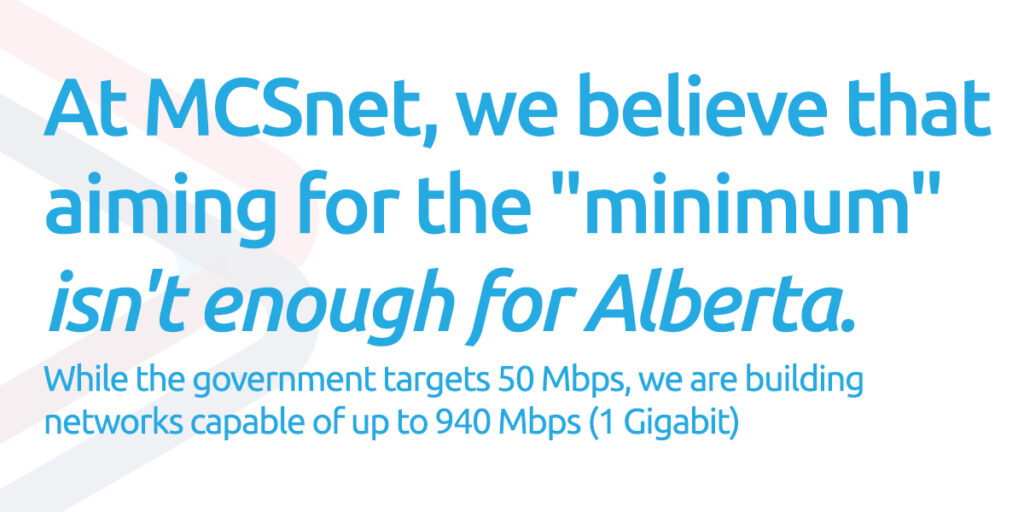
At MCSnet, we believe that aiming for the “minimum” isn’t enough for Alberta. While the government targets 50 Mbps, we are building networks capable of up to 940 Mbps (1 Gigabit).
Why? Because technology doesn’t stand still. The internet you need for today’s 4K streaming is different from what you’ll need for tomorrow’s precision farming or telehealth services. We aren’t just building for 2026; we’re building for 2036.
How We Are Getting There: It’s Not Just Cables in the Ground
The biggest challenge in rural Alberta is geography. Trenching fiber-optic cables to every single acreage and farmhouse is incredibly expensive and slow—especially when the ground is frozen for half the year.
If we relied only on buried fiber, many of you would still be waiting in 2030 and beyond.
That’s why MCSnet pioneered GigAir. Think of it as “fiber through the air.”
- How it works: We run high-capacity fiber lines or licensed, wireless links to our towers (that’s the “backbone”). Then, using advanced GigAir and other high-speed, wireless technology, we beam that signal wirelessly to a small receiver on your home or business.
- The Result: You get fiber-like speeds (up to 940 Mbps) without anyone having to dig up your driveway.
This technology allows us to deploy faster and reach further than traditional, large telcos.
Boots on the Ground: Progress in Your Community
We don’t just talk about expansion; we’re out there doing it. Over the past 5 years, we’ve aggressively expanded our network thanks to our own private investment and partnerships with the Universal Broadband Fund.
- Innovation in Mind: We have not only launched GigAir in over 80 towns, villages, and hamlets, we are now launching super fast speeds across the countryside with the goal of upgrading the majority of our towers by the end of 2026.
- Community Spotlights: We are currently lighting up high-speed zones in communities like Ardrossan, Barrhead, Bon Accord, Bonnyville, Cold Lake, Gibbons, Lac La Biche, Lloydminster, Morinville, Redwater, St. Paul, Vermilion, Vegreville, Wainwright, Westlock, and Wetaskiwin. These also include the rural municipalities surrounding these communities.
- Investing in Home: To date, MCSnet has secured millions in funding that goes directly into hardware and infrastructure for our service area—not Calgary or Edmonton.
Beyond 2026: Why Speed Matters
Why do we push for Gigabit speeds when the government only asks for 50 Mbps? Because rural Alberta deserves the same opportunities as the big cities.
- For the Economy: It allows local businesses to compete globally and farmers to use autonomous machinery.
- For Families: It means your kids can game online with their friends without lagging, and you can video chat with the grandkids in crystal clear quality.
- For Safety: It ensures reliable access to emergency alerts and telehealth appointments, allowing seniors to age in place comfortably.
Check Your Tech
If you haven’t checked your internet options in the last six months, you might be surprised by what’s available. Thousands of homes that were previously in “dead zones” or stuck on slow legacy plans are now eligible for GigAir and other high-speed fixed wireless technology.
Don’t settle for slow. Check your address today.
Related Articles
30 Years of Rural Support and Community Connections
Fiber vs. GigAir: The Ultimate Showdown Between Internet Titans

2026 Internet Buyer’s Guide for Rural Alberta: Best Speeds, Plans, & All You Need to Know